Jon came over to disconnect a washer and dryer in my house. He was on time, very professional and such a nice person. Jay the owne…



Licensed: CSLB #517514, C-36 • Bonded & Insured • BBB Accredited • 2026 BBB Torch Awards for Ethics finalist • Fountain Valley & Huntington Beach Chambers of Commerce
An earthquake gas shutoff valve closes your gas line automatically when the ground shakes hard enough. It also goes by seismic gas shutoff valve, gas seismic valve, or gas earthquake valve. In Orange County, we install two styles: the dome type and the Little Firefighter. Both are certified by the California Division of the State Architect. Either valve shuts the gas off without power, batteries, or Wi-Fi.
Key Takeaways
Jump to a section
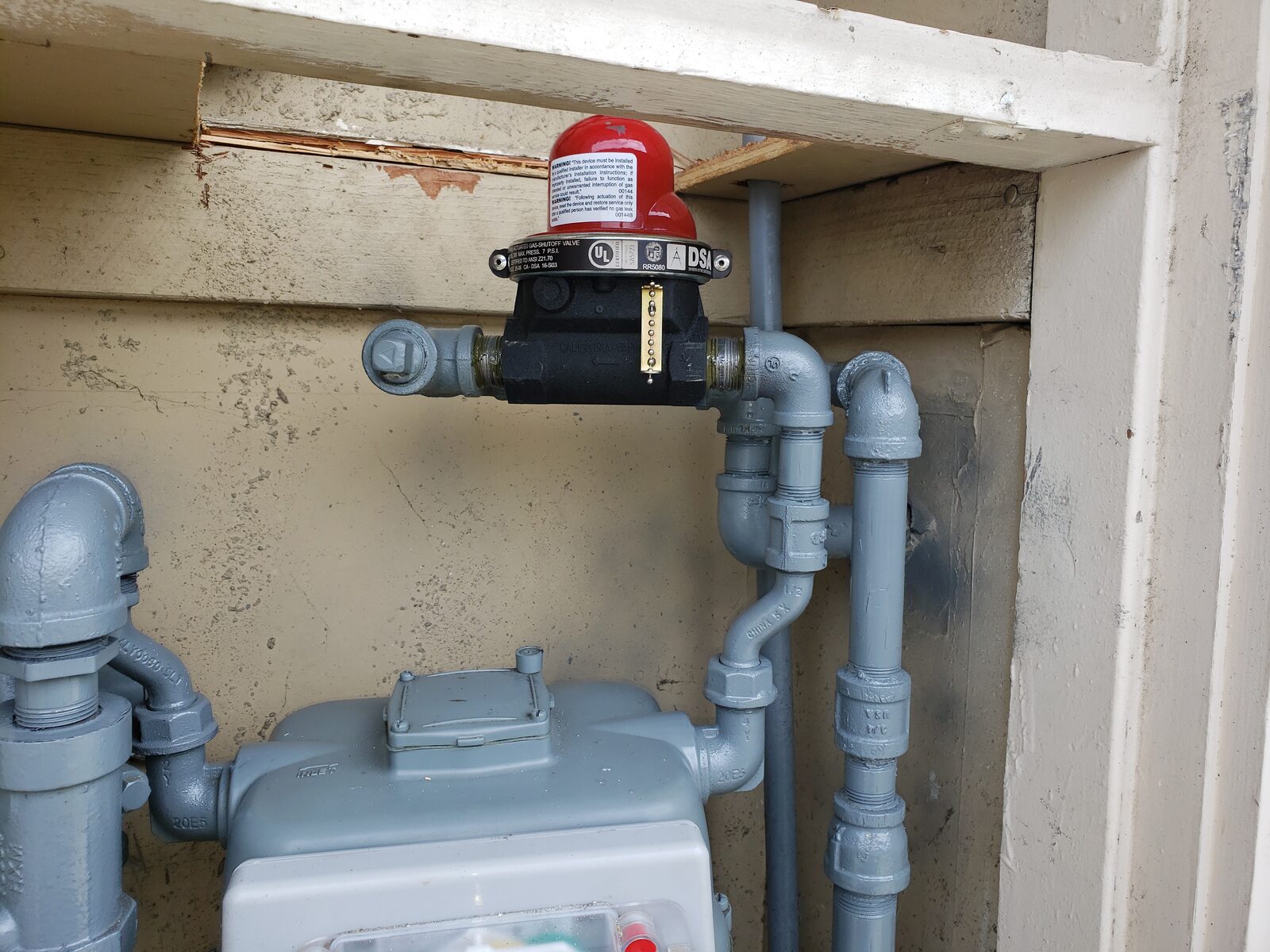
An earthquake gas shutoff valve is a purely mechanical valve. It sits on the gas line right after your gas meter. Under normal conditions, gas flows through it and you never think about it. When the ground shakes with enough force, the valve trips closed on its own. Gas stops. The building is isolated from the meter until a person resets the valve by hand.
These valves go by several names: seismic gas shutoff valve, gas seismic valve, gas earthquake valve, and automatic gas safety shut off valve. The names all describe the same job. It is an automatic gas shutoff valve at the gas meter that closes when it feels a quake. The valve does not know the difference between a broken gas pipe and a cracked appliance connection. It removes the fuel from the picture the moment shaking passes its threshold. A leak that opens during a quake does not find a flame.
The valve sits on the customer side of the meter. It is your property, not the utility's. Southern California Gas Company owns and services the piping and the meter up to the outlet spud on the meter itself. Everything after that point, including this valve, is a customer plumbing item and part of your home's broader natural gas service. A licensed plumbing contractor is the trade that installs it and services it.
Three things are driving the call volume on this in Orange County right now. First, a door-to-door scam we want to warn readers about before anything else. Second, home insurance underwriting. Finally, real estate transactions.
A running scam in Orange County works like this. A person shows up at the door claiming to be from Southern California Gas Company. They promise the utility will pay a rebate if the homeowner installs an earthquake shutoff valve on the spot. Southern California Gas Company does not offer any such rebate. Orange County Patch reported one case out of Tustin. If someone at your door tells you a rebate exists, close the door. Call a licensed C-36 plumbing contractor with a real address, a phone number the utility can verify, and a permit filed with the city building department before work begins. You can also reach the SoCalGas scam alert line at 1-800-427-2200.
Over the last couple of years, more Orange County homeowners have called us with the same question. Their insurance company or agent has asked whether the home has an earthquake gas shutoff valve. In a few cases, the agent has asked the homeowner to install a seismic gas shutoff valve as a condition of a new policy or a renewal. We are not the insurance carrier. We are hearing this more often than we did five years ago, and the request usually comes from the homeowner's side. If your insurance agent has raised the question, call us and we will handle the install.
We have also had a small number of Orange County homeowners tell us their realtor asked for a seismic gas shutoff valve before closing on the sale of the home. Orange County does not have a countywide law requiring one. Some California jurisdictions, including the city of Los Angeles under Municipal Code section 94.1217.0, do require a certified valve at point of sale, and Orange County realtors and buyers have been following that same expectation on their own. A realtor can ask for it as a condition of the deal, and buyers do notice its absence during inspection. If your agent has asked for a valve at sale, call us and we will handle the install before closing.
Every earthquake gas shutoff valve on the market uses the same basic physics. Inside the valve body sits a small steel ball resting in a cup. The cup holds the ball right on the edge of stability. Gas flows around and past the ball. When the ground moves hard enough, the ball rolls out of the cup, drops through a hole in the seat, and lands on a plunger. That plunger closes the gas passage and locks the valve shut. The design is simple on purpose, because it has to work the first time, in the dark, while the ground is still moving.
The trip threshold on the models we install is calibrated to ground motion consistent with a magnitude 5.4 quake or higher at the valve. That sensitivity range is what the California Division of the State Architect (DSA) certifies. The valves are engineered to ignore the vibrations that would otherwise cause false trips: a passing truck, a slamming garage door, a lawnmower on the other side of the wall, or a kid jumping off the bumper of the car. If your valve trips without a quake, that is a sign to check the mounting and the meter environment first.
Once a valve is tripped, it stays tripped. There is no automatic reset. Someone has to walk up to the meter, verify no gas is leaking, and reset the valve by hand. That intentional friction is the safety feature. It stops the gas from coming back on until a person has looked at the situation.
California state law backs this design standard up. Under California Health and Safety Code sections 19200 through 19204, any seismic gas shutoff valve sold in the state must be certified by the State Architect. The valves we install meet that standard.
Two valve families cover almost every install we do in Orange County. Both are DSA-certified. Both have decades of field history on Southern California homes.
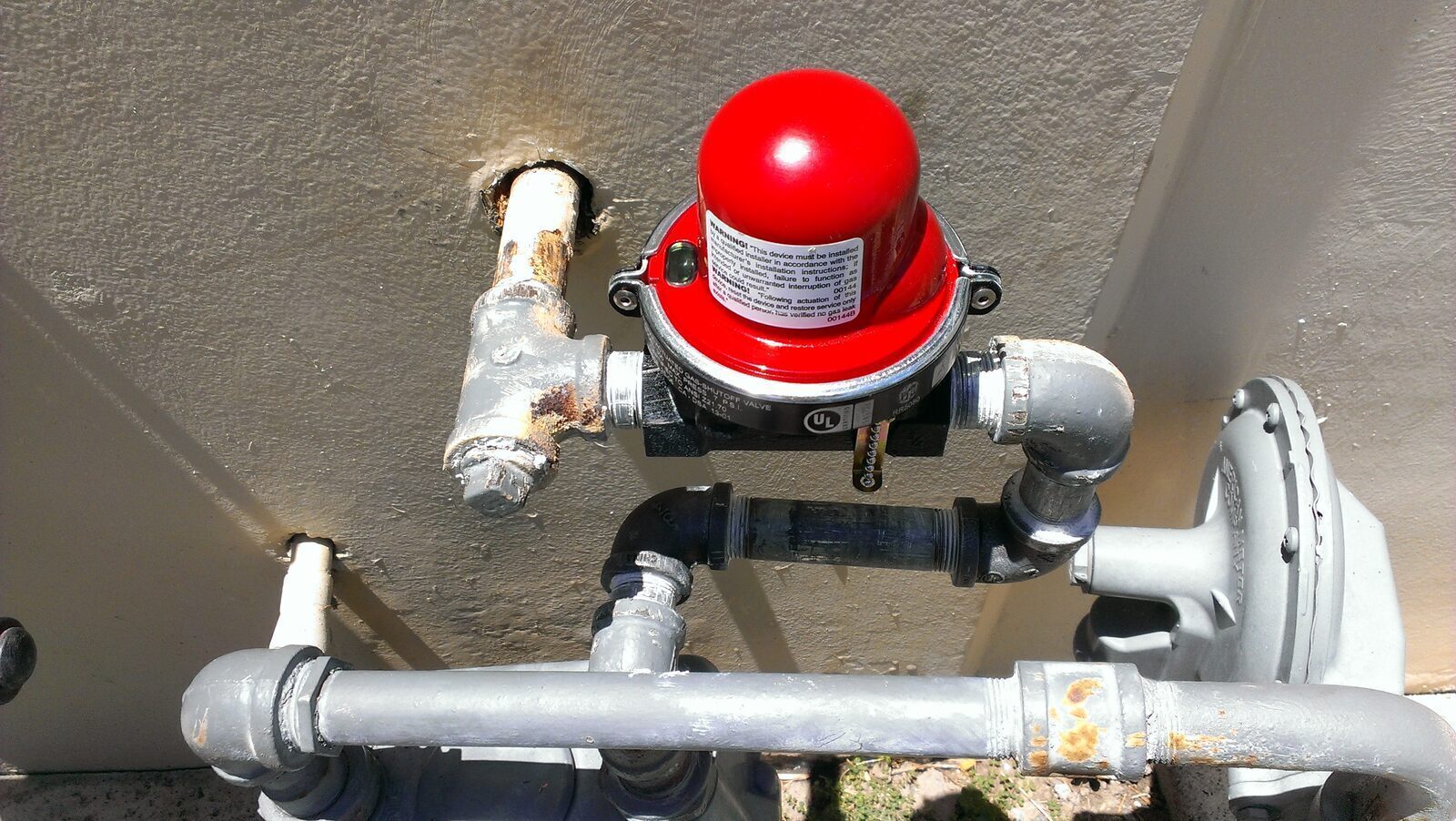
The dome type is the red, half-globe valve you have probably seen on Southern California meters for years. The trip mechanism lives under the dome. When it trips, you can see it. A small indicator on the dome tells you the valve is closed. On the residential sizes, the reset is a pull-chain or knob on the underside of the dome. On some sizes it is a slotted screw that turns 1/8 of a turn with a flat-blade screwdriver. The dome type comes in a wide range of pipe sizes and pressure ratings, from 3/4-inch residential to 2-inch commercial risers.
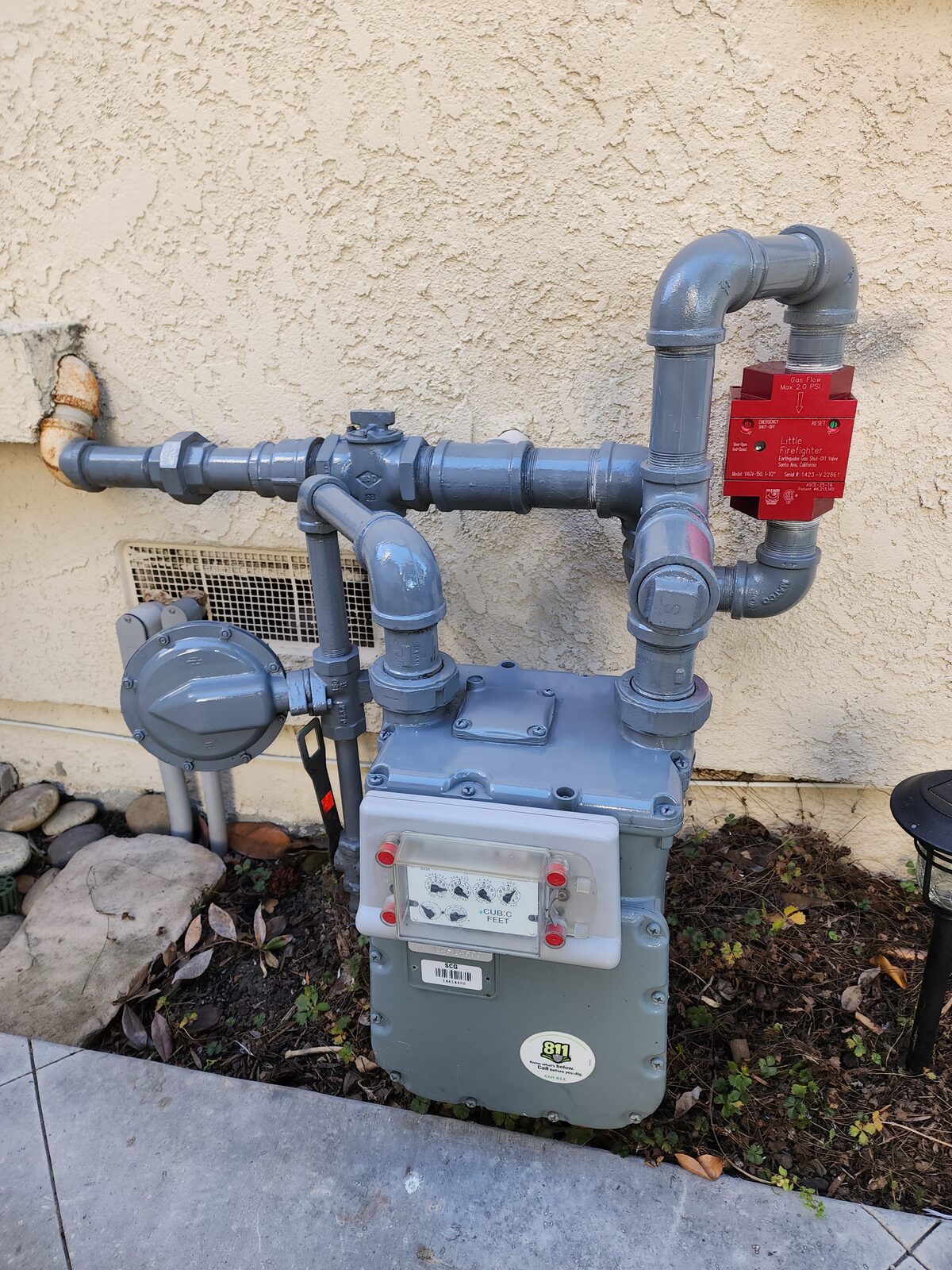
The Little Firefighter is a rectangular red valve made in Santa Ana. It carries the DSA State Architect certification stamped right on the body. Orange County inspectors we have worked with accept it without question. Three versions cover the field: the AGV series for horizontal installs, the VAGV series for vertical installs, and the FAGV flanged version for larger commercial jobs. The reset is a slotted screw on top of the housing, marked STOP and RESET. The instruction is stamped on the valve itself: 1/8 turn only, with a flat-blade screwdriver. If a homeowner has to reset it, the answer is written on the valve.
Both valves do the same job to the same standard. The choice usually comes down to what fits the meter set with the least amount of piping change. We look at parts availability the day of the install. Sometimes the homeowner has a preference too. For a straight residential 3/4-inch meter with room on either side, either valve drops in cleanly. For a large commercial meter set or a low-clearance install, one may be the better mechanical fit than the other. We look at the meter first and then talk through the trade-offs.
The valve has to sit in the same orientation the manufacturer certified it for. The physics only works if gravity pulls the ball down onto its seat when it moves. A horizontal-rated valve installed sideways or upside down will not close reliably. A vertical-rated valve installed on horizontal pipe will do the same thing: nothing, when it matters.
Orange County meter sets split roughly evenly between the two orientations. The difference comes from how the meter and the house were originally piped.
| Piping orientation | Where you commonly see it | What we install |
|---|---|---|
| Horizontal outlet (line runs sideways out of the meter) | Most single-story homes; meters mounted on a rear wall or side yard | Horizontal-rated valve (Little Firefighter AGV or horizontal dome type) |
| Vertical outlet (line runs up out of the meter) | Two-story homes, meters with the regulator on top, tight setbacks that force the line up before it turns | Vertical-rated valve (Little Firefighter VAGV or vertical dome type) |
| Awkward angle (line runs at 30 to 60 degrees off level) | Rare, usually a hillside install or a remodeled meter set | Reroute a short section of piping so the valve sits either true horizontal or true vertical |
This is the reason we have to look at the meter before we quote the job accurately. A phone quote against "my meter is on the wall" can miss by a factor of two if the meter set forces a vertical install or if the line comes out at an angle. Sending a photo of the meter goes a long way toward a firm number on the phone.
Almost every earthquake gas shutoff valve install in Orange County falls into one of two categories: the easy install or the offset install. The category the meter falls into is the single biggest driver of what the job takes. It is also the thing homeowners are usually most surprised by.
The easy install is a meter set with 6 to 8 inches of straight pipe between the meter outlet and the first elbow or the wall penetration. We call the gas utility for a shutoff. Then we cut the existing black iron pipe or steel nipple, thread the valve into the run, and put the section back together. The valve occupies space that was already there. No new piping has to be routed around anything. The house is back on gas the same day.
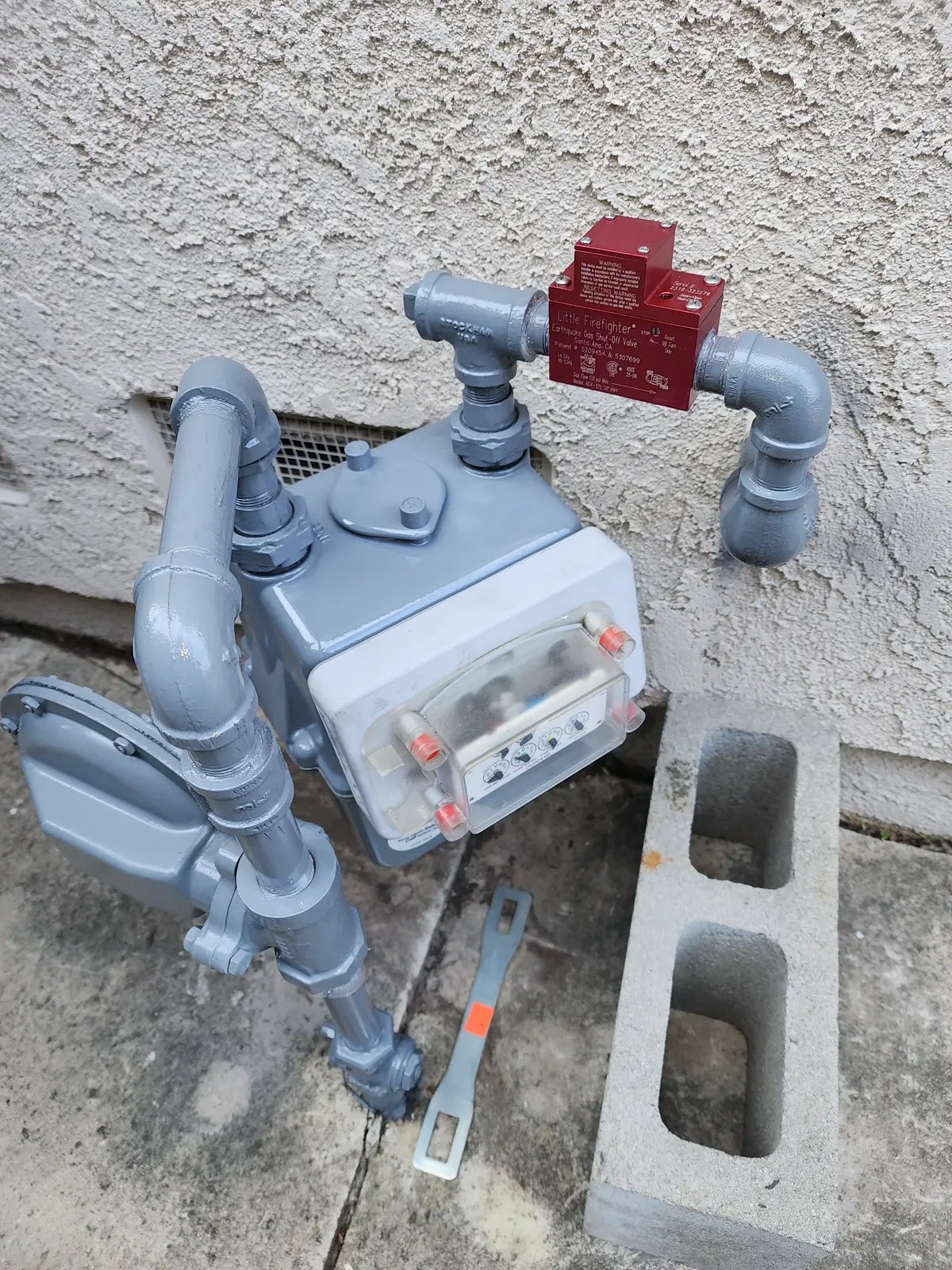
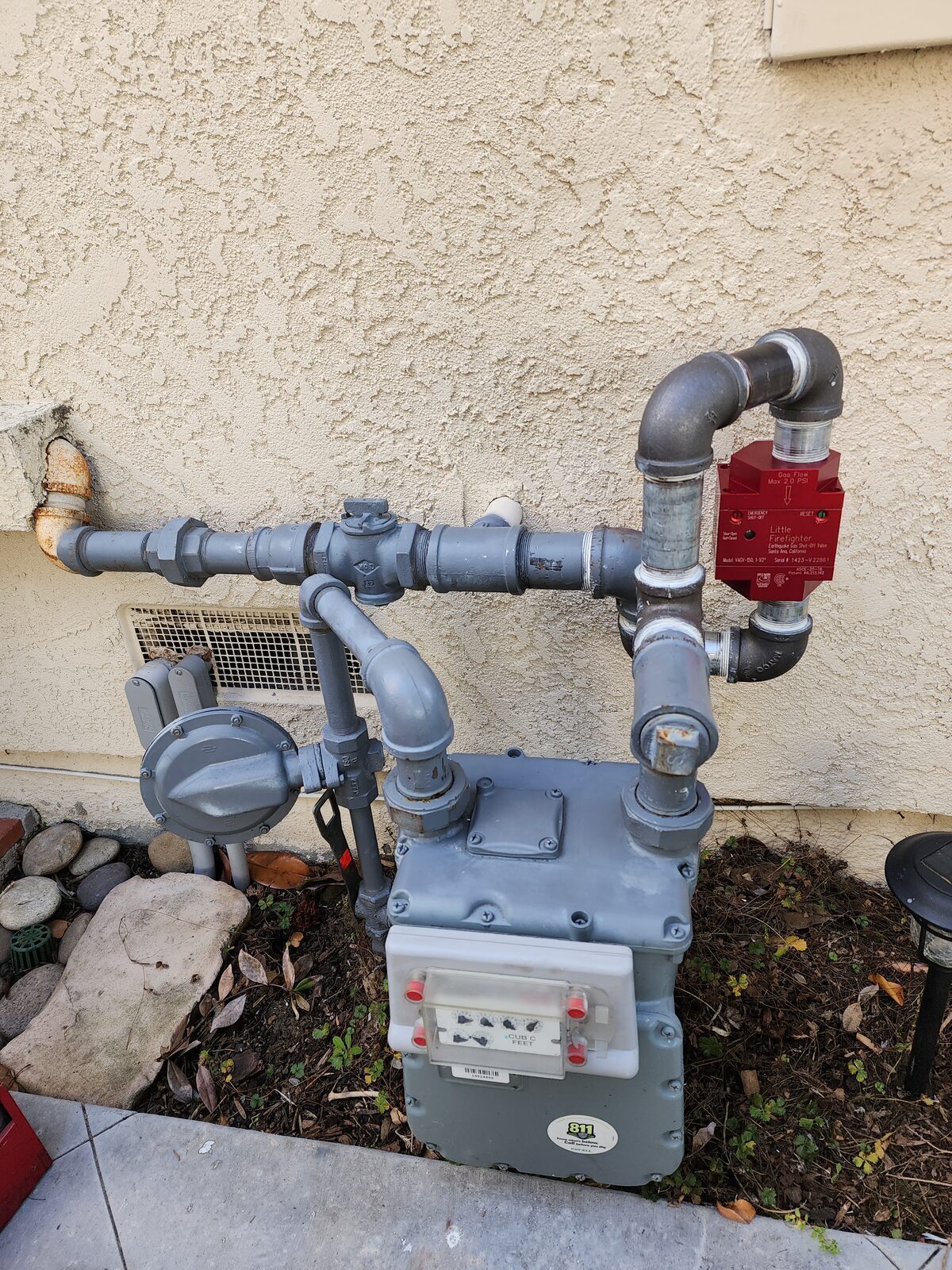
The offset install is a meter set that does not have room for the valve where the manufacturer wants it. It is common on tight side yards, on meters recessed into a stucco cove, and on meter sets that share space with an electrical panel or a hose bib. In those cases, the piping around the meter has to be reworked to make room. First, we add a short jog of pipe to one side. Then we drop the line down or up a few inches to give the valve clearance. Finally, we bring the line back to where it needs to enter the house. The valve itself is not any more complicated to install. The piping around it takes an extra hour or two.
Every extra fitting is one more threaded connection to seal. It is one more joint to leak-check. It is one more piece of black iron pipe to cut, ream, thread, and dope. If a meter set needs four extra fittings to make the valve fit, that is four more places where the work could leak. The valve itself is not the variable. The routing around the valve is. When you ask us for a phone estimate on this job and we ask for a photo of the meter, this is what we are looking at.
Gas work is permitted work. Every earthquake gas shutoff valve install we do in Orange County gets a plumbing permit pulled with the local city building department before we start. When the gas comes back on, we leak-check every joint we made on the new valve. That confirms the joints are tight before we hand the meter back to you.
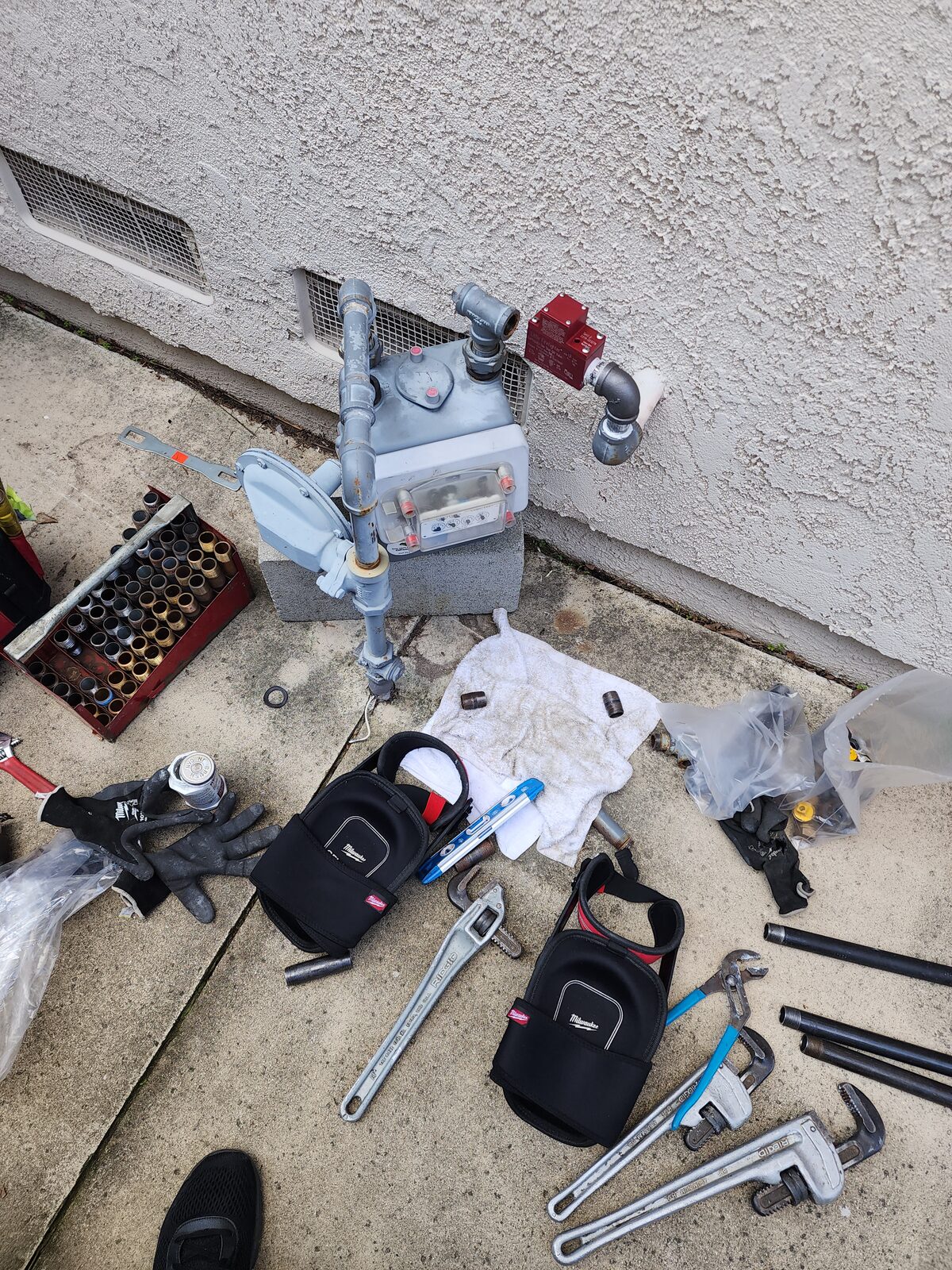
If your water heater, furnace, wall heater, or older stove has a standing pilot, we relight it before we leave. Newer appliances with electronic ignition do not need a relight. They self-light the first time the appliance is called. If a pilot will not relight, or if you smell gas inside the house after we leave, call us back the same day at (714) 964-3519.
We pull the plumbing permit before we start and schedule the city inspection once the work is complete. The inspector wants to see the valve installed in the certified orientation and the valve model listed on the approved-valve list. Both dome-type valves and Little Firefighter valves clear the standard Orange County city inspection lists we have seen.
Before you reset the valve, do these three things.
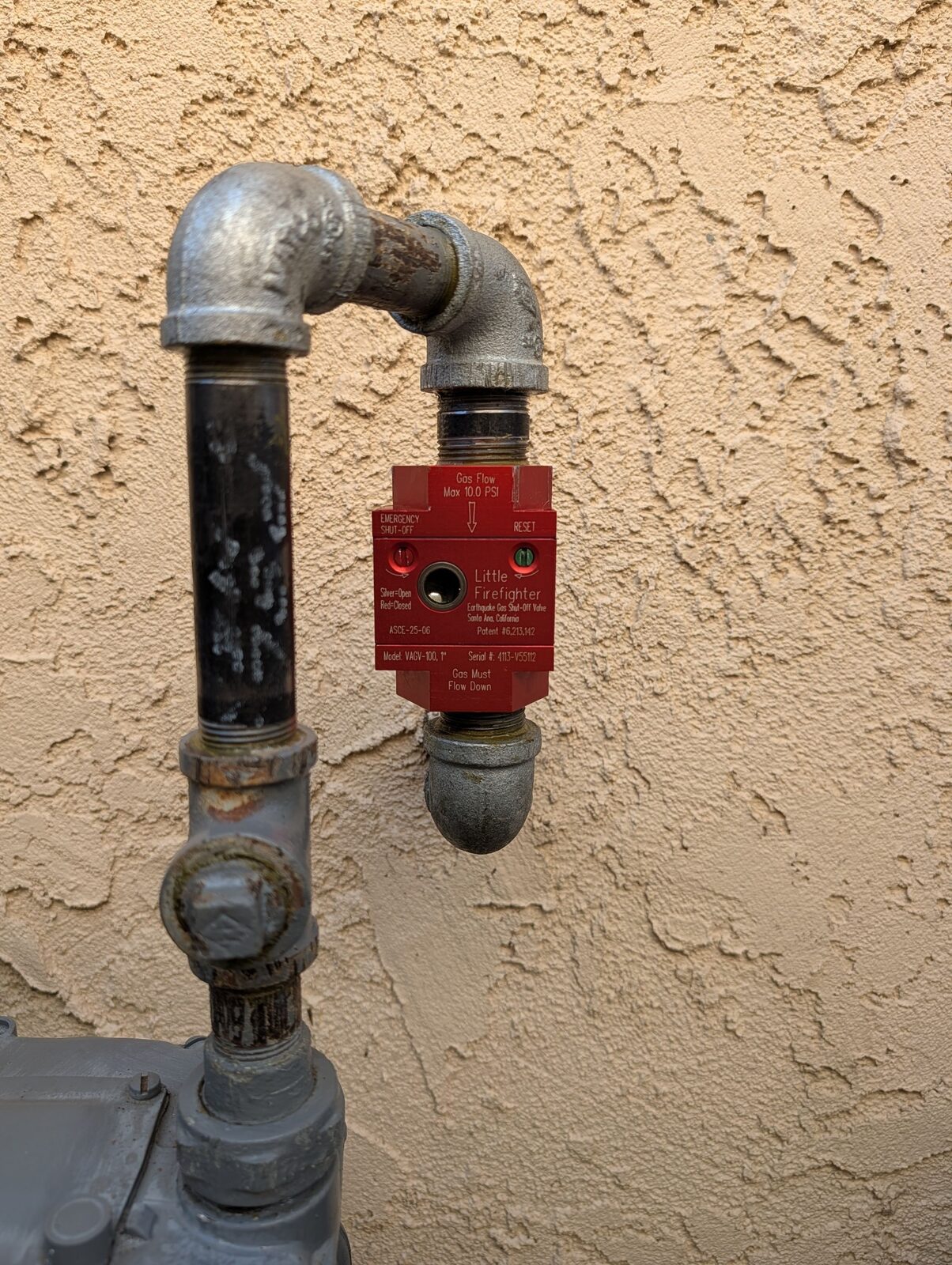
The Little Firefighter has the reset instruction stamped right on the top of the housing. STOP is on one side. RESET 1/8 TURN ONLY is on the other side. Between the two labels sits a slotted screw. Put a standard flat-blade screwdriver in the slot. Turn it exactly 1/8 of a turn toward RESET. That is one small movement, not a full rotation. The valve is now armed and gas is flowing again. Overrotating the screw can damage the reset mechanism, which is why the valve says 1/8 turn only.
The dome type varies by size and model. On the residential 3/4-inch and 1-inch dome valves, the reset is a small chain or pull-tab hanging from the underside of the dome. Pull the chain straight down until you feel or hear the ball click back into its cup. On the larger dome valves, the reset is a slotted screw on the bottom of the housing. The procedure is the same as the Little Firefighter: 1/8 turn with a flat-blade screwdriver. The reset direction is stamped on the housing.
A tripped seismic valve interrupts gas for long enough that appliances with a standing pilot go out and stay out. Modern gas water heaters and furnaces have a relight procedure printed on the front panel. If your water heater is more than 15 years old, or if the pilot will not stay lit after you follow the printed instructions, that is a call. We can walk you through it on the phone. If the appliance needs a technician on site, we will send one.
Call us. We answer our own phones 24 hours a day, every day of the year. There is no answering service; you reach someone from the company directly. We will send a plumber to reset the valve, verify no leak, and relight the pilots. Especially after a real quake, it is fine to want a set of trained eyes on the meter before the gas comes back on. That is what we are here for.
We do not publish flat dollar amounts on this page. The real number depends on two things we cannot see from a phone call: the size of your gas line, and how much routing the piping needs around your meter. Whether it lands as an easy install or an offset install is what actually moves the price.
We give a free written estimate for every earthquake gas shutoff valve install, at your meter, before we start. There is no obligation to schedule. Take the estimate home, get a second read from another company, and decide from there.
Orange County does not have a countywide requirement for an earthquake gas shutoff valve. However, some California jurisdictions do require one at point of sale. In Orange County, most homeowners install an earthquake gas shutoff valve for insurance, for peace of mind, or because their realtor asked for the valve at the sale of the home.
Some homeowners have called us saying their insurance agent asked about a seismic gas shutoff valve during underwriting or a renewal. In a few cases, the agent has told the homeowner to add a seismic gas shutoff valve as a condition of the policy. We are not the insurance carrier. If your agent has raised the question, call us and we will handle the install.
No. Southern California Gas Company does not currently offer a rebate for installing an earthquake gas shutoff valve. Anyone at your door claiming otherwise is running a scam. You can verify by calling the SoCalGas customer line at 1-800-427-2200.
No. The earthquake gas shutoff valves we install are certified to ignore ordinary vibration: passing trucks, garage doors, appliances, and foot traffic. The trip threshold is calibrated to real seismic acceleration, not to construction vibration. False trips happen occasionally. They are usually a sign the valve was mounted out of level or the meter set is loose.
Earthquake gas shutoff valves are certified to trip in ground motion consistent with a magnitude 5.4 quake or higher at the valve. Smaller quakes and distant quakes usually do not trip the valve. A close, sharp shake is more likely to trip it than a slow, rolling one of the same magnitude.
The clearest sign your earthquake gas shutoff valve is tripped is that no gas appliance in the house works: no hot water, no stovetop, no furnace. Both the dome type and the Little Firefighter have a visible indicator on the housing that shows the closed position. Walk up to the meter and look at the valve. The indicator tells you where it stands.
In most Orange County cities, a homeowner cannot install an earthquake gas shutoff valve. Gas piping work requires a permit and a licensed C-36 plumbing contractor. Some cities allow a qualified homeowner-installer with prior city approval. Even in that case, the valve has to sit in the manufacturer-certified orientation, or it will not close when it counts.
A straight easy install of an earthquake gas shutoff valve on a residential meter runs one to two hours on site. We allow time for the leak check on the new joints and the utility shutoff. An offset install where we have to rework the meter piping runs two to four hours. Every job ends the same day and you are back on gas before we leave.
Both are DSA-certified seismic gas shutoff valves that use a ball-in-cup trip mechanism. The dome type is the red half-globe valve common on Southern California meters. The Little Firefighter is a rectangular valve made in Santa Ana with the reset instruction stamped on the housing. Both do the same job, and the choice usually comes down to which one fits the meter set best.
Earthquake gas shutoff valves are designed to sit untouched for the life of the meter. There is no annual service call. We do recommend a quick visual check every year or two: confirm the valve is upright and level, confirm the indicator reads open, and confirm the reset mechanism is not painted over or bent. If the meter got painted during a house repaint and the reset chain got painted stuck, that is worth a service call.
If you're deciding whether an earthquake gas shutoff valve makes sense at your home or business, here is the order that saves you the most time and money:
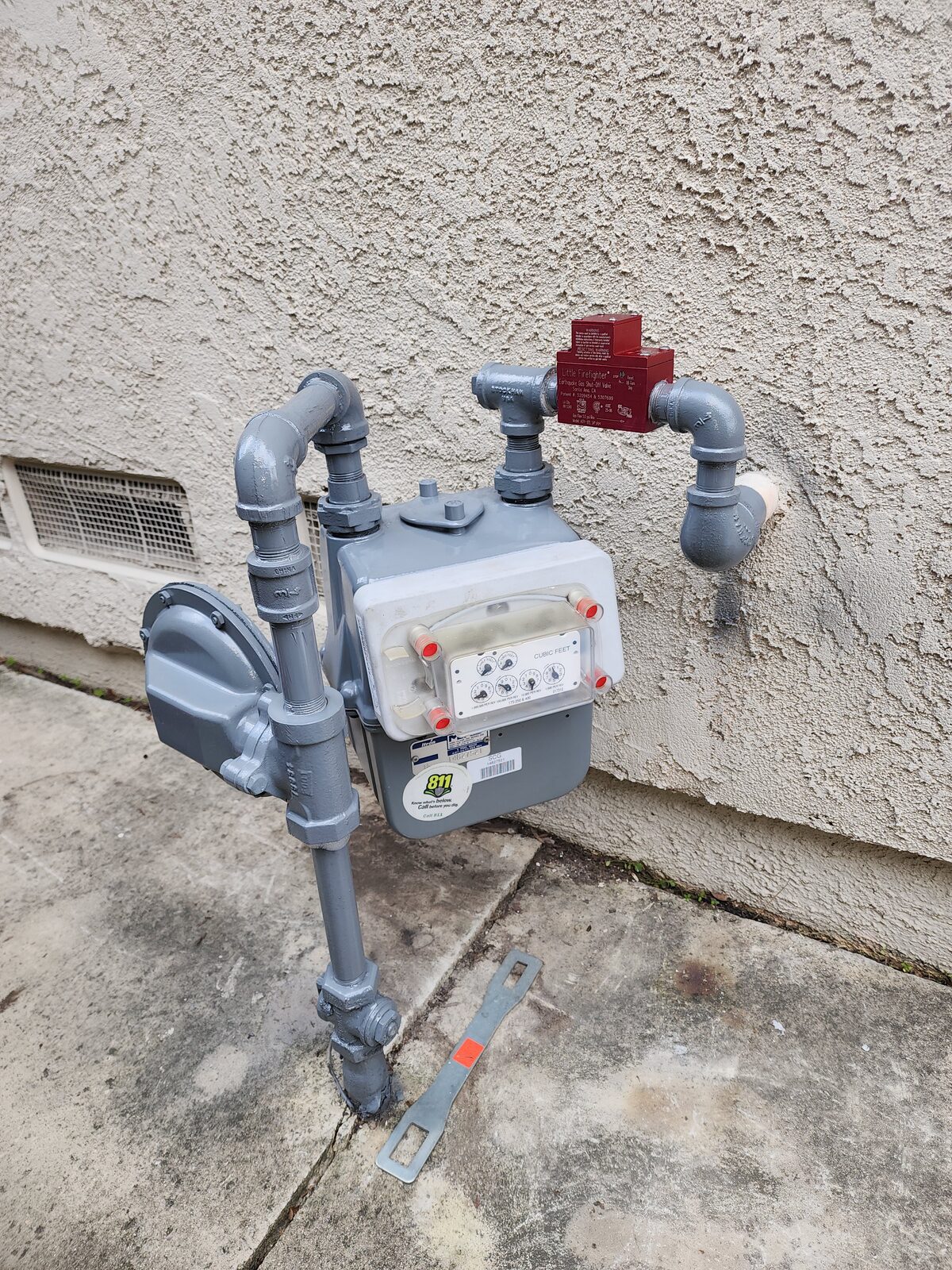
If you'd like us to come out and take a look, we're available 24 hours a day, every day of the year. Written quotes are provided at no charge during business hours, Monday through Saturday, for work we can see and price on site. Diagnostic work, when needed to find a hidden problem, is quoted before we begin. The repair is then quoted in writing before any repair work starts. After hours and on Sundays, the visit is at overtime rates. We give a two-hour window and call when the truck is on the way. If the earthquake gas shutoff valve install turns out to be a straight drop-in on your meter, we'll tell you that. If the meter needs offset piping to fit the valve, we'll walk you through the options and the cost on each one.
Disclaimer
Plumbing codes vary by jurisdiction and are updated periodically. The code references in this article reflect current California Plumbing Code requirements as of August 26, 2026. Local building departments may apply additional requirements or amendments. Confirm current code requirements for your specific city or county with the local building department before relying on this article for permitted work.
Disclaimer
This article describes how some plumbing situations are typically treated by homeowner's insurance policies in California. Actual coverage depends on the specific policy and the specific situation. Professional Plumbing is not a licensed insurance professional. For coverage questions about your specific policy, contact your insurance carrier directly.
More gas-line help for Orange County
Seismic gas shutoff valves are one piece of the gas-line work we do across the county. The countywide gas line repair and installation hub covers gas leak repair, black iron and polyethylene line replacement, and tankless upsizing. City-specific gas installation service pages are available for Huntington Beach, and our fullcover gas emergencies at any hour.

About the author
Professional Plumbing, Inc. Founded and owned by William J. Horsky Jr., 1985. CSLB 517514 C-36, held since 1987. Incorporated 2001. Offices in Fountain Valley, Garden Grove, Huntington Beach, Costa Mesa, and Newport Beach. Serves homeowners and businesses across Orange County.
This page was updated on October 12, 2026.
Have a question?
If you're trying to understand whether an earthquake gas shutoff valve makes sense at your home, weighing your options, or working through what your insurance agent asked for, you're welcome to call. The number is (714) 964-3519.
Day or night, you'll reach me or my sister Liz. After hours and it can wait? Feel free to book online anytime.
There's no obligation to schedule service. We like talking to people in our community, and sometimes a phone call answers what an article cannot.
William J. Horsky Jr.
Owner, Professional Plumbing, Inc.
Serving Orange County since 1985.
Jon came over to disconnect a washer and dryer in my house. He was on time, very professional and such a nice person. Jay the owne…
These 2 were fast, efficient, clean, friendly and taught me a lot about old plumbing habits that I've been doing totally wrong. Ni…

These 2 were fast, efficient, clean, friendly and taught me a lot about old plumbing habits that I've been doing totally wrong. Ni…
Always on time and polite.
Great service!! and I always get a good tip too to help keep my drains moving!
Professional Plumbing is worth their weight in Gold. Had a previous current water bill showing an increase in high water usage in …
A special shout out to Darin and Oscar for their honest, knowledgeable and kind service concerning what we thought was a slab leak…
Nick, Oscar, Dustin and Vince are the best. We trust them with all our plumbing needs, residential and commercial.
We have had many different plumbers do work for us over the years. That has all come to an end. We are sticking with Professional …
I work for Meadowlark Golf Club and when I called, Jay, the owner, and his entire team were fantastic! I ended up calling three da…
I had spoken to Nick the regional manager, and he was very honest about what we were looking at for our slab leak. I think they're…
I have been using them for many years, they are an honest company and I never felt they were out to get me, always explained the p…
I have used Professional Plumbing several times, always with excellent results. They are my go to plumbers. They are friendly, pun…
We've relied on Professional Plumbing for all our plumbing installations and repairs for over ten years and they've never let us d…
Jay and his team are highly professional and easy to work with.
Great experience all around. Responsive to emails and texts and did an excellent job installing our Seismic shutoff valve.
Nick Haas is an amazing plumber. He has worked on my houses for about 26 years, and I have always been impressed by his profession…
Have always been very happy with work done by Professional Plumbing, both when we were remodeling as well as any subsequent repair…

Prompt, professional, and very reasonable. Very happy with their service!
Professional and respectful.
Every once in a blue moon you meet someone who renews your faith in humanity. I had an emergency leak in my bathroom tonight. My p…
Nick and his colleague installed a new angle stop and feedline. They ensured I knew where the main shut-off was. They did an excel…
I needed a fix to my shower faucet. A pro arrived with everything needed to complete the job. Chris advised in detail and got to w…
Chris Kirsten was outstanding. He helped me with replacing a toilet and getting an old shower to work again! He went above and bey…
We always call Professional Plumbing when we have a problem. They are knowledgeable, reasonably priced, prompt and respectful of o…
I called in near panic as the water line into the pool broke and I couldn't turn the main water source off myself. I called a plac…
Very friendly and patient plumbers who, as other reviewers have stated, know things that most plumbers don't. They let me watch an…
Absolutely the most professional service! They not only did a great job but cleaned up as well. They worked as if my home were the…

Chris is a top-notch professional. Everything about my repair was better than I expected. I noticed the leak right at end of day, …