

Gas installation service in Orange County: lines and leaks
By William Jay Horsky Jr., Owner, Professional Plumbing, Inc. · Published May 31, 2026 · Updated June 26, 2026
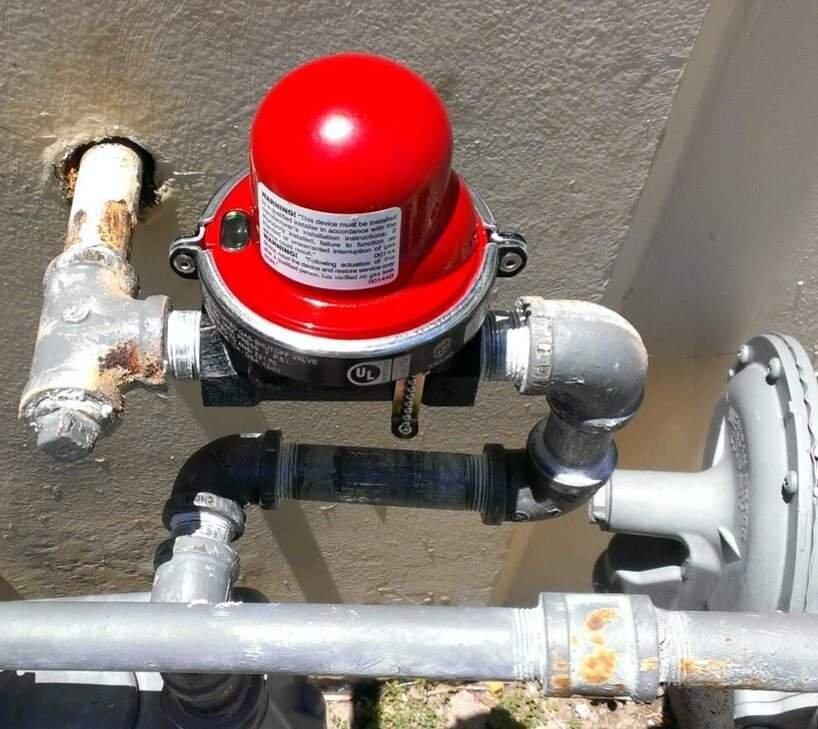
Gas installation service in Orange County covers everything on your side of the gas meter: the gas lines in the walls, attic, and yard, the shut-off valves, the earthquake shut-off valve, and the final connection to every gas appliance. The gas company owns the line up to the meter; past the meter, the whole system is ours to install, repair, move, or replace.
Key Takeaways
- Gas installation service in Orange County is licensed, permitted work: California requires a C-36 contractor for any gas line or appliance job, and every line is pressure-tested before the gas goes back on.
- You will not hear a hiss from a normal gas leak. The pressure is too low. The smell comes first, and it is the one thing you should never ignore.
- Underground gas lines made of old steel usually have to be replaced, not patched. Once steel rots through in one spot, the rest of the run is rarely far behind.
- Earthquake gas shut-off valves are a fast-growing category, driven by insurance and realtor requests. Full guide on our earthquake gas shutoff valve page.
What gas installation service covers
We cover the lines in the walls and the attic, the lines buried in the yard, the shut-off valves, the earthquake valve at the meter, and the final connection to each appliance: the furnace, the water heater, the range, the dryer, the pool heater, and the fire pit out back. We find and repair leaks, run new lines, move or remove lines for a remodel, and pressure-test systems to prove they are tight. If it is natural gas and it sits on your side of the meter, we handle it.
A couple of gas jobs live on other pages because they belong there. The gas connection on a new water heater is part of that install, and commercial gas systems run through our commercial work. Everything else under gas installation service, for a house in Orange County, lands here.
By the numbers. Across more than 36,900 Orange County jobs since 1985, gas work has been steady, year-round work for us. Over roughly the last twenty years, our logged jobs include more than 1,600 gas leak repairs across Orange County: about one in seven were on underground lines, and the rest were above ground at fittings, valves, and appliance connections. Earthquake-valve installs are a separate and fast-growing category.
The gas line in your home, from the meter to the appliance
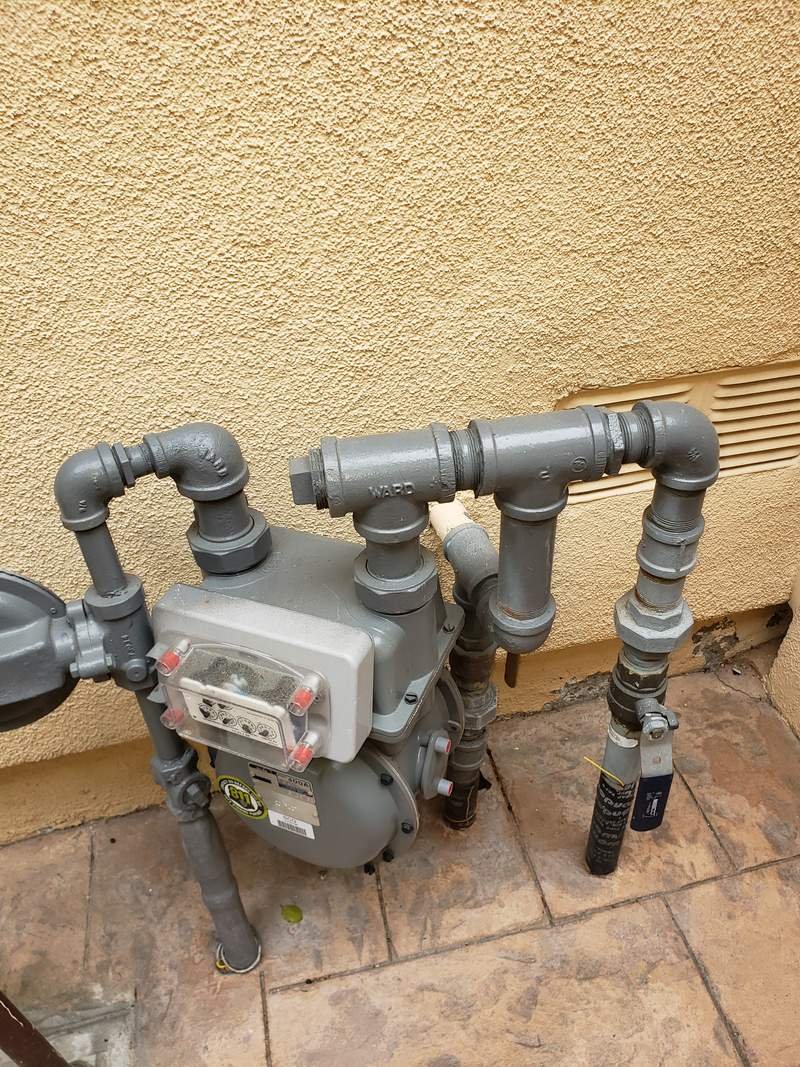
Most homeowners never think about the gas line until something goes wrong, so here is the quick map. The gas company's line ends at your meter, usually near the street or on the side of the house. From there, the gas runs at low pressure to each appliance. Inside the house and above ground, that pipe is almost always threaded steel, what the trade calls black iron. Buried in the yard, it is yellow polyethylene, a plastic made for gas, run with a tracer wire so the line can be found again later. Each appliance has a shut-off valve, and many homes now have an earthquake valve at the meter that closes the whole house off if the ground shakes hard enough.
One thing is worth knowing, because it is the thing that saves lives. Natural gas has no smell of its own. The gas company adds a chemical called mercaptan to give it that sharp rotten-egg odor, and they have done so since the 1930s. Your nose can catch it at a tiny concentration, long before the gas reaches a dangerous level in the room. That smell is not a nuisance. It is the warning system doing its job.
The gas calls we run most in Orange County
If you want to know what a gas plumber in Orange County does in a typical week, most of it is leaks. Most of those are above ground, at a fitting, a valve, or an appliance connection. The harder calls, the ones that take a crew and a trench, are on the underground line between a meter that sits out in the yard and the building it feeds. You see that setup most in older condo and apartment communities, where it was cheaper to bring one line in underground than to bring every meter up above ground the way newer construction has to.
After leaks, the steady work is gas lines for tankless water heaters. A tankless unit burns far more gas at once than the old tank it replaces, so it usually needs its own larger line run from the meter. Then come remodels, where a water heater or a dryer is being moved or added and the gas line has to move with it. We install drip legs and fresh shut-off valves on those jobs as a matter of course.
There is also a particular Orange County one, fire rings. On a lot of older installs, the burner ring was mounted with the holes facing up instead of down. Water collected inside the ring, sat there, and rotted it out from the inside. And then there is the call that has taken off lately, earthquake valves, which gets its own section below, because what is driving the demand is not earthquakes. It is insurance.
Gas leaks: how we find them and how we fix them
Let me clear up the biggest myth first. Unless you have a major leak, you are not going to hear a hiss. The pressure in a home gas line is too low for that. Standard SoCalGas delivery to a house is only about 8 inches of water column, roughly a third of a pound, and a leak at that pressure seeps out quietly instead of hissing. The half-pound figure people repeat is really the 14 inches of water column an appliance is rated to accept, not what the utility delivers. What you will notice is the smell, that rotten-egg odor everybody knows. There is one other tell most people have never heard of.
Flies are drawn to the smell of gas. If you notice flies gathering around a gas line outside, there is a good chance you have a leak you have not found yet. The dead patches of grass people expect to see are mostly a commercial-property thing, because at a house you will almost always smell the gas long before it ever kills the lawn.
How we find and repair the leak
When we arrive, the method depends on the size and location of the leak. For a small leak at a fitting or an appliance, the old soap test still works: brush soapy water on the joint and watch for bubbles. We also carry electronic sniffers that detect gas in the air. For a leak we cannot see, we run a pressure test, and that part takes time. Code does not let us test against a shut-off valve, and the small appliance valves cannot hold the pressure we test at, so we have to cap off each line individually.
Underground leaks are more of a headache than the ones you can see. Locating the leak is rarely the problem. The pipe itself is. Underground line is often old steel, and once steel has rusted through in one spot, it is usually weak along the whole run. A single patch rarely holds, so the real fix is replacing the line in polyethylene with the right transition fittings on each end. With old steel underground, the cost is in the digging, so replacing the run beats chasing one rotten joint after another.
When the gas company shuts the gas off
One more thing every homeowner should understand, and it has to do with the gas company. Southern California Gas Company can shut your gas off for any detectable leak. Once they do, they will not turn it back on until the whole system is proven tight. They run a pressure test so sensitive that the smallest leak sets it off, and service does not come back until we have tested and fixed the entire system and they have tested it again behind us. So if you smell gas strongly, call the gas company. They do not always shut you down, but they can, and that is the price of being safe. The one thing you should never do is ignore the smell.
Earthquake gas shut-off valves
This is the fastest-growing gas call we run, and the reason is not earthquakes. It is insurance. An earthquake gas shut-off valve mounts on the outlet side of your gas meter and closes automatically when the ground shakes hard enough. More Orange County homeowners are being asked to install one by their insurance agent or their realtor before closing on a home sale.
For the full guide on how these valves work, how to reset one, what an install day looks like, and what drives the cost, see our dedicated earthquake gas shutoff valve page.
What we install, and the materials we use
If you are getting quotes for gas installation service in Orange County, a little material knowledge helps you ask sharper questions.
Above-ground pipe: steel, CSST, and MegaPress
Above ground, we run threaded steel, black iron. It is the standard and it lasts. There is also a flexible product called CSST, corrugated stainless steel tubing, sold under names like TracPipe and Gastite. We do not use a lot of it, because we tend to find leaks on it over time, but it earns its place when a fitting is in a spot you cannot get a wrench on, or a run has to turn at an awkward angle.
If a plumber does install CSST, there is one detail worth asking about: bonding. Standard yellow CSST has to be bonded to the home's grounding system with a copper jumper no smaller than 6 AWG, clamped to rigid metal pipe ahead of the first CSST fitting rather than to the tubing itself. That requirement comes from the National Fuel Gas Code (NFPA 54) and the manufacturer's instructions that California follows, not from the electrical code. The bond gives a nearby lightning strike a path to ground instead of letting it arc through the thin tube wall, and it is exactly the kind of step a rushed install skips. Newer arc-resistant CSST, the black-jacketed products, can be listed to go in without that separate jumper, so the rule depends on which product is used.
We have also been reaching more and more for a press system called MegaPress, which seals a fitting with a crimping tool and an O-ring instead of threading or welding. It is faster and easier on the homeowner's cost, and it has held up well for us. The work has to be done right: we de-burr and clean every pipe end so the O-ring seats against a clean surface, and we use the correct gas-rated fittings, the ones with the special HNBR O-ring. A yellow dot on the fitting is the tell that it is approved for natural gas. We run Viega fittings, which build in a feature that flags an unpressed connection during testing.
Underground pipe, and what is no longer allowed
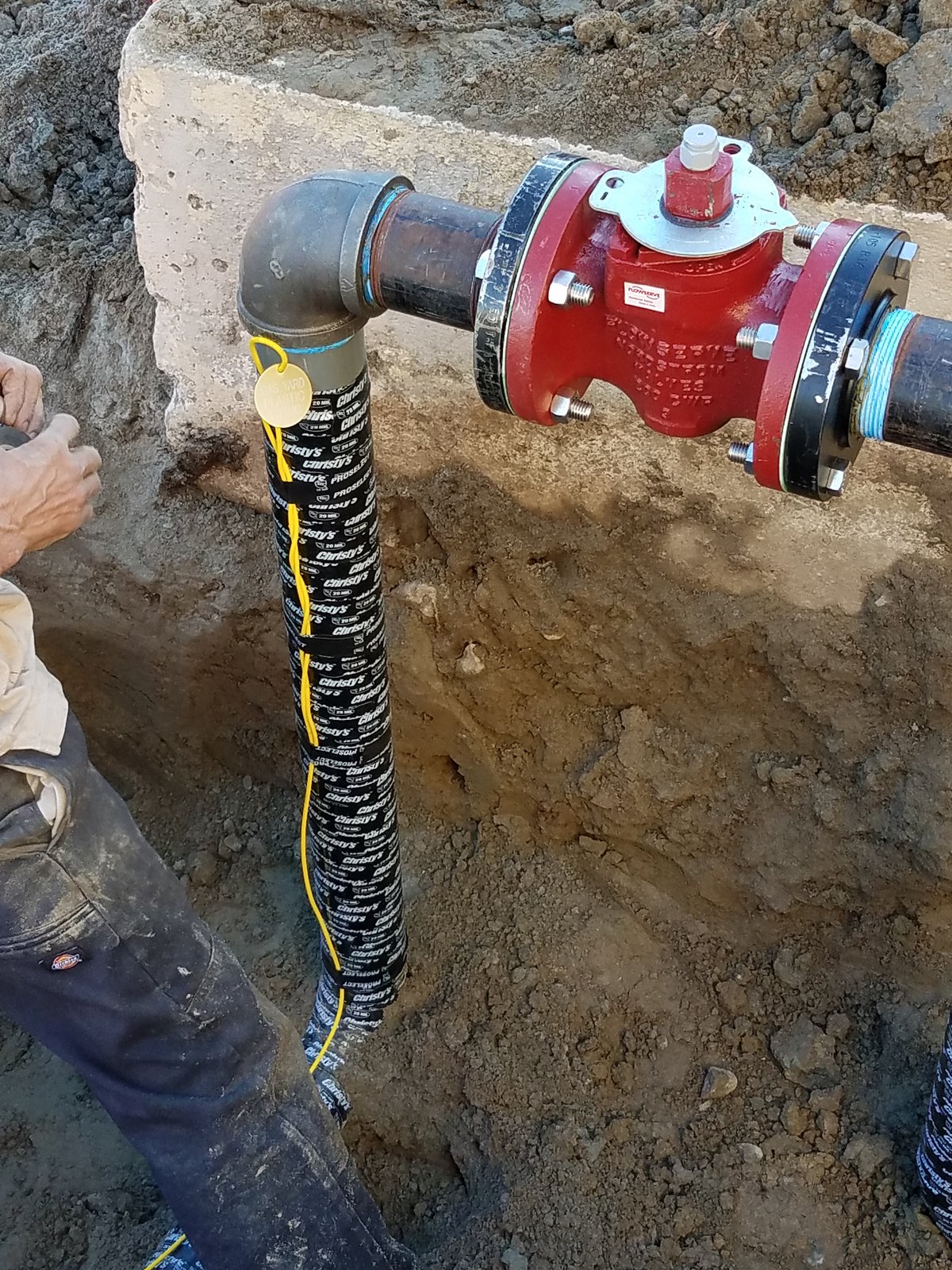
Underground, the right material is yellow polyethylene, PE, run with a tracer wire so the line can be located later. Two older materials are no longer permitted for gas at all, and this matters if you own an older Orange County home: copper and PVC. Copper was used for gas back in the late 1950s and early 1960s, which never made sense to me, because you cannot solder a gas joint. If we open a system and find copper, PVC, or old steel gas line running under the concrete slab of the house, we have to stop. That line cannot stay in service, and it does not get dug out and replaced in the same spot. We cut it and abandon it where it lies under the slab, then reroute new gas piping in an approved material, run overhead or around the slab instead of back through it.
The gas pipe we run, and where
Different parts of a gas system call for different pipe. Here is what we install on an Orange County job and why.
| Material | Where it is used | Why |
|---|---|---|
| Black iron (threaded steel) | Indoor, above-ground lines in walls and attics | Strong and the code standard for interior gas |
| Yellow polyethylene (PE) | Underground lines in the yard | Made for buried gas; run with a tracer wire and 18″ minimum cover (we trench to ~24″) |
| CSST (corrugated stainless) | Some interior runs and appliance connections | Flexible and faster to route; must be properly bonded and grounded |
| Rigid steel | High-BTU connections such as a pool heater | Required where a flex connector cannot safely carry the load |
| PVC and copper | Not permitted for gas in California | Wrong material for fuel gas — we never use them on a gas line |
New lines for new things: tankless, fire pits, generators
A lot of gas work in Orange County is adding gas where there was none. Before any of it happens, there is a step most homeowners never see. Any time we add or change something on a gas system, we run a load calculation to confirm the existing pipe can carry the new demand. We measure every run at the house, then take it back to the office to draw the isometric and size each piece of pipe to the total BTU load.
That load calculation is the honest answer to "can you just tap into my existing line?" Sometimes the answer is yes. Sometimes the existing pipe is already carrying all it can, and the new appliance needs its own run from the meter. A tankless water heater is the classic case, because it demands far more gas at once than the old tank it replaced.
On the backyard and lifestyle side, the real picture is more modest than the marketing you will see elsewhere, and I would rather be straight about it. Pool and spa heater lines are usually run by the pool builder, and we rarely see those lines go bad. Built-in barbecues are uncommon now; most people just want a simple exterior gas outlet, and outdoor-kitchen stub-outs are usually handled by the contractor. We are even seeing the opposite trend, where a homeowner who has gone solar caps a gas line off because their electricity is essentially free.
How a gas job works, from the knock to the gas coming back on
Every gas installation service job starts a little differently. If the gas company has shut off the meter, the first thing we ask for is the red tag or pink slip, so we can read exactly what we are up against. Then we confirm the leak, which is almost always there, and work out the rest: what kind of line it is, where it is leaking, and whether it is an easy soap-test find or something buried.
When the line is underground, the first thing we look for is a tracer wire. If the line has a tracer wire and a tag, it is plastic, PE or PVC, and we know what we are dealing with. If there is no tracer wire, the line is most likely old steel, but we still have to dig it up to be sure, both to confirm it is steel and to rule out a plastic line where someone simply forgot to lay a tracer wire. Either way, old steel underground usually means replacing the run rather than patching it.
Testing, inspection, and getting the gas back on
On a new install or a line we are moving, the load calculation comes first, so we know the pipe and meter can carry the demand. The pressure test does not come first. It comes right before we call the inspector, because the inspector needs to see the test itself.
On an emergency leak, the order changes. We stop the leak and get the hazard under control first, and deal with the permit afterward. If the repair is underground, we leave the trench open so the inspector can see the work. On a longer line that has to be tested, we run the pressure test before the inspector arrives so he can witness it, and we connect the gas only after he signs off. On a short repair, only four or five feet of pipe, the inspector will often let us reconnect the gas on the spot, because the line is too short to put a full test on.
After the inspection, the gas company comes back out, confirms the system is tight, turns the meter on, and relights the pilots. We line that up so the time without gas stays as short as we can make it.
Repair or replace, and moving a line for a remodel
Not every gas installation service call is a fresh install. A lot of it is changing a system that is already there, and the honest repair-or-replace conversation usually comes down to the material and its age. On old steel, especially underground, a single leak is rarely a single problem. The threads corrode at every joint, and a line rotten enough to leak in one place is usually rotten along its length. We can repair a section, but if the steel crumbles when we open it up, the right call is to replace the run in PE rather than chase leak after leak. We will tell you which one you are looking at before we start, not after.
Moving a line for a kitchen or bathroom remodel is more straightforward. If we are relocating a line a short distance and not adding any load, we do not have to redo the gas calculations, because the demand is not changing. If the remodel adds an appliance or extends the system, the load calculation comes back into play. Capping off a line, for an appliance that is coming out or a system someone is abandoning for electric, is a small job done right: the line gets capped, tested, and left safe.
What you can safely do, and what to leave alone
I believe most homeowners are mechanically capable, and I am not going to pretend otherwise. The honest reason to leave gas work to a licensed plumber is not that you could not learn it. It is the stakes, the tools, and the law. An untested line that leaks is a serious hazard, so if you ever touch a gas line, it has to be tested before it goes back into service. The specialized tools run into the thousands of dollars, and most suppliers will not rent them out because of the liability. And California law requires a licensed C-36 contractor and a permit for gas line and gas appliance work, regardless of the size of the job. That is the state's rule, not ours.
Here is the short list of what a homeowner can safely handle around gas:
- Keep a gas shut-off wrench at your meter, so you can turn the gas off fast in an earthquake or any other emergency.
- Turn off the shut-off valve behind or beside an individual appliance, such as the one behind the stove, when you need to.
- Reset a tripped earthquake valve with a screwdriver at the meter. It is not a single-use part.
- If you smell gas, leave and call the gas company. That is the whole job. Do not go looking for the leak yourself.
What to leave to a plumber
One I will not warn you off is the gas flex, the flexible connector at an appliance. Someone mechanically capable can change one. The thing is, a gas flex rarely needs replacing unless it gets damaged, so most homeowners never have to touch it. What I would leave alone is anything that means moving or rerouting a line, running a new line to a barbecue or a pool heater, or reusing an old flex. We never reuse an old gas flex; for the price of a new one, it is not worth the risk. And a pool heater has to be plumbed in steel, never a flex, because it burns too many BTUs for anything but a solid connection.
Permits, code, and Orange County city differences
Any time a gas line is moved or the gas system is opened up, the work is supposed to be permitted. How the permit gets handled is where Orange County cities differ. Some take the application online, others want it in person.
The code difference we run into most is on underground replacement. Buried gas line has to be deep enough to stay protected. Under the 2022 California Plumbing Code, plastic PE gas pipe needs at least 18 inches of cover plus a tracer wire so it can be located. There is a provision that lets a hardscape like a concrete walkway count toward that cover, since the concrete adds protection of its own. We do not play that game with an inspector. Instead, we dig the whole trench to about 24 inches, deeper than the minimum, so there is never a question about whether a few inches of concrete makes up the difference. That way the job defaults to the worst case and stays 100 percent to code.
On pricing, gas work follows the same approach as the rest of what we do. If we can come out and see the problem without pulling tools off the truck, the look is free. The moment a job needs a pressure test or a leak locate to diagnose, that is billable work, and you get a written price for it before we start. Most of the time we can quote the repair on sight, because we can see what is wrong. Either way, the price is in writing before any work begins.
Real Orange County gas jobs
Here is a recent one, with the identifying details left out.
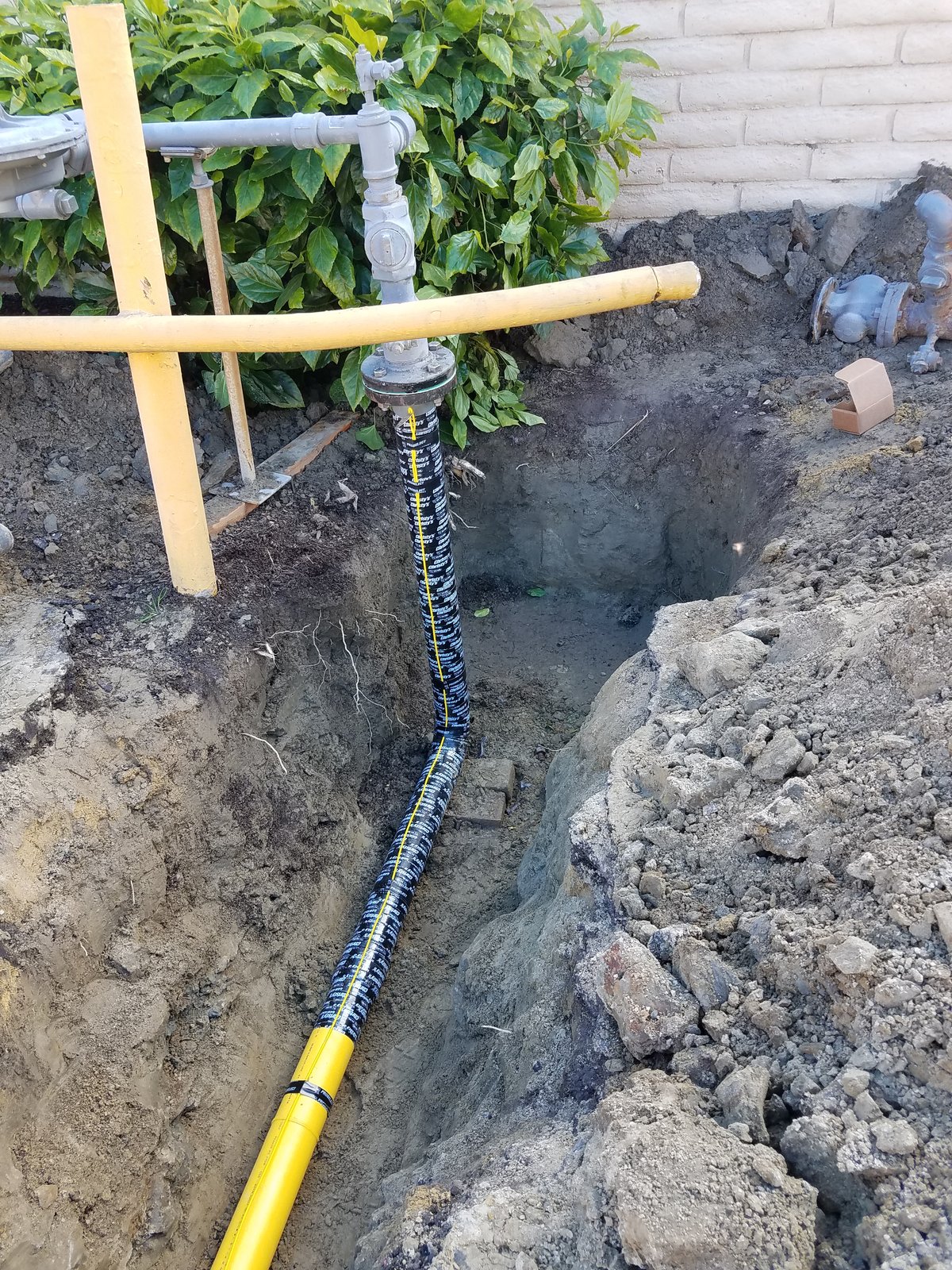
A golf course in Orange County: 350 feet and a fusion machine
The gas company red-tagged the line at a golf course in Orange County, where 350 feet of 3-inch gas line ran underground to the buildings and the pro shop. We capped the line and filled it with air, and it would not hold pressure. Digging down by the restrooms, we found a rotten riser and, behind it, 3-inch PE plastic line. We cut out the old section, used a butt-fusion machine to weld in new 2-inch PE, set a new meter riser, and tied it back into the building line. The gas company came out, leak-tested it, found it clean, and turned the gas back on. We backfilled and compacted everything behind us.
We do gas work across Orange County, including Costa Mesa, Irvine, Fountain Valley, and Garden Grove.
A second opinion on a big gas quote
Most gas calls come in well under the threshold where a second opinion matters. The bigger jobs are the ones worth a second look, because the price can be large and the diagnosis is not always right. What we see, especially on underground lines, is a homeowner told they need an entire new line when the real problem is a leaking valve. Replacing the valve would fix it; replacing the whole line sells a lot more work. It is less common on gas than on sewer lines, but it happens.
A while back, we were called out on a gas leak where the homeowner had already been quoted to replace the entire line running out to their fire ring, all of it buried under concrete and brick. We tested it first. The leak turned out to be a loose packing nut on the log-lighter valve, the valve that turns the fire ring on and off. We tightened the nut, retested the line, and that was the whole repair.
That is the reason the offer exists. If you have gotten a quote for a job of $2,500 or more and would like a second opinion, we do them for free. The customer needs to have a written estimate from the other company. Call or ask for details. If it turns out to be smaller than you were told, we will tell you that, and the decision is yours from there.
Frequently asked questions
Will I hear a hissing sound if I have a gas leak?
You usually will not hear a hiss from a gas leak. Unless the leak is very large, the gas pressure in a home line is too low to make an audible hiss. The reliable warning is the smell, the rotten-egg odor the gas company adds on purpose. Outside, an unexpected swarm of flies near a gas line or a dead patch of grass can also signal a leak. If you smell gas, leave and call the gas company.
What should I do the moment I smell gas in my house?
Get everyone outside to fresh air. Do not flip switches, light anything, or start a car in an attached garage, because a spark is the danger. If you have a wrench and know your meter, you can shut the gas off there from outside. Then call Southern California Gas Company at 1-800-427-2200. Do not go back in until the home is cleared.
Can a leaking underground gas line be patched, or does it need replacing?
Whether a leaking underground gas line can be patched depends on the material. Old steel line that has rotted through in one spot is usually failing along its whole length, so a patch buys little time and the right answer is to replace the run in polyethylene. We dig up a short section first to see what we are dealing with. A line with a locating tag and tracer wire is plastic; a line with neither is most likely steel and most likely due for replacement.
Do I need a permit for gas line work in Orange County?
Gas line work in Orange County requires a permit. Any time a gas line is moved, extended, or opened up, the work is supposed to be permitted, and California requires a licensed C-36 contractor for gas work regardless of the job size. How the permit is handled varies by city, with some Orange County cities online and others in person. We handle the permit as part of the job.
What kind of pipe should be used for a buried gas line?
Underground gas lines today are run in yellow polyethylene, PE, with a tracer wire so the line can be located later. The 2022 California Plumbing Code requires at least 18 inches of cover for plastic gas pipe. We trench deeper than the minimum, around 24 inches, so there is never a question at inspection. Copper and PVC are not permitted materials for gas.
My tankless water heater installer says I need a bigger gas line. Is that real?
Usually it is real. A tankless water heater burns far more gas at once than a standard tank, so the existing line and meter often cannot carry the added demand. Before adding any appliance, we run a load calculation on the whole system and size the line to the total BTU demand. Many tankless installations need a dedicated larger line run from the meter.
Can I install my own gas line or hook up my own gas appliance?
California requires a licensed C-36 contractor and a permit for gas line and gas appliance work, for good reason: an untested line can leak and create a serious hazard, and the specialized tools cost thousands of dollars. A homeowner can safely keep a shut-off wrench at the meter, close an appliance shut-off valve, reset a tripped earthquake valve, and leave and call the gas company at the smell of gas. The pipe work itself should go to a licensed plumber.
How to get gas work started
If you need gas installation service and there is no emergency:
- Note what you are trying to do or what you have noticed: a new appliance, a remodel, a smell that comes and goes, a red tag from the gas company, or an insurance request for an earthquake valve.
- If the gas company has red-tagged your meter, keep the tag or pink slip. We will want to read it.
- If another company has given you a written quote of $2,500 or more, set it aside for a free second opinion.
Gas installation service across all of Orange County
We handle gas installation service throughout Orange County, not only the areas listed here. Pick the office or service area nearest you for local details:
If you would like us to come out
We are available 24 hours a day, every day of the year. During normal business hours, Monday through Saturday, an estimate is free for work we can see and price on site. If diagnosing the problem takes a pressure test or a leak locate, we quote that diagnostic work in writing before we begin. The repair or installation is quoted in writing before any work starts. After hours and on Sundays, the visit is at overtime rates. We give a two-hour window and call when the truck is on the way.
If it turns out to be smaller than you feared, a packing nut instead of a whole new line, we will tell you that. If it is a bigger job, we will walk you through the options and the cost on each one, in writing, before any work begins.
Disclaimer
Plumbing and fuel-gas codes vary by jurisdiction and are updated periodically. The code references in this article reflect California Plumbing Code and related California requirements current as of May 31, 2026. Local building departments may apply additional requirements or amendments. Confirm current requirements for your specific city or county with the local building department before relying on this article for permitted work.
If you smell gas
If you smell gas right now, treat it as the priority and take these steps in order.
- Get everyone out of the house and into fresh air. Do not flip light switches, do not light a match, and do not start a car in an attached garage. A spark is the one thing you are trying to avoid.
- If you know where your gas meter is and you have a shut-off wrench, you can turn the gas off at the meter from outside. If you are not sure, leave it and get clear.
- From outside the home, call Southern California Gas Company's 24-hour emergency line at 1-800-427-2200.
- Do not go back inside until the gas company has checked the home and told you it is safe.
The gas company comes out for this at no charge, day or night. Calling them is the safe move, every time.
Other services from our crew
Gas work connects to the rest of the house. Beyond it we also handle drain and sewer service, slab leak repair, everyday plumbing repair, and fixture installation. Get going with a quote or contact us.

About the author
William Jay Horsky Jr. owns Professional Plumbing, Inc. He founded the company in Orange County in 1985 and has run more than 36,900 plumbing jobs across the area since then. The company has been licensed by the California Contractors State License Board since 1987 (CSLB license number 517514, classification C-36, current and active), incorporated as Professional Plumbing, Inc. in 2001, and is a 2026 BBB Torch Awards for Ethics finalist. It operates from offices in Fountain Valley, Garden Grove, Huntington Beach, Costa Mesa, and Newport Beach, and serves homeowners and businesses across Orange County.
Have a question?
If you are trying to understand a gas problem at your home, weighing your options, or working through what an insurance company is asking you for, you are welcome to call. The number is (714) 964-3519.
During business hours you will reach me or my sister Liz. After hours, our AI assistant can answer common questions or take down your information, and I will follow up the next business day. In the event of an emergency, our AI assistant can connect you directly to a plumber at your request.
There is no obligation to schedule service. We like talking to people in our community, and sometimes a phone call answers what an article cannot.
William Jay Horsky Jr.
Owner, Professional Plumbing, Inc.
Serving Orange County since 1985.
What our gas-line customers say
Real reviews from our Google Business Profiles across Orange County.
★★★★★
“Good communications and professional performance. Nice to have a licensed professional to soap test outside gas connections.”
— Eric Steen, verified Google review, 2026/06/24
★★★★★
“The expert plumbers at Professional Plumbing Inc. responded quickly to our emergency need and successfully repaired my damaged gas line and restored heat to our home, assuring a safe return to normal daily routines. Their professional services and solution-oriented approach significantly reduced our worries and left us impressed with the entire experience.”
— Munchie, verified Google review, 2025/03/26
★★★★★
“These guys were great, they gave me options to replace my water heater with a tankless. They explained what all the pros and cons were. Since we had a small gas line they said I needed a new line to make sure there was enough gas to heat the water. The work was done very clean and even my wife was happy how clean they left it. We will definitely call them next time we need something. Thank you Chris and Dustin for such a nice installation.”
— Wheeet, verified Google review, 2026/03/30