


Automatic Water Shutoff Valves for Orange County Homes: Before You Buy
Licensed: CSLB #517514, C-36 • Bonded & Insured • BBB Accredited • 2026 BBB Torch Awards for Ethics finalist • Fountain Valley & Huntington Beach Chambers of Commerce
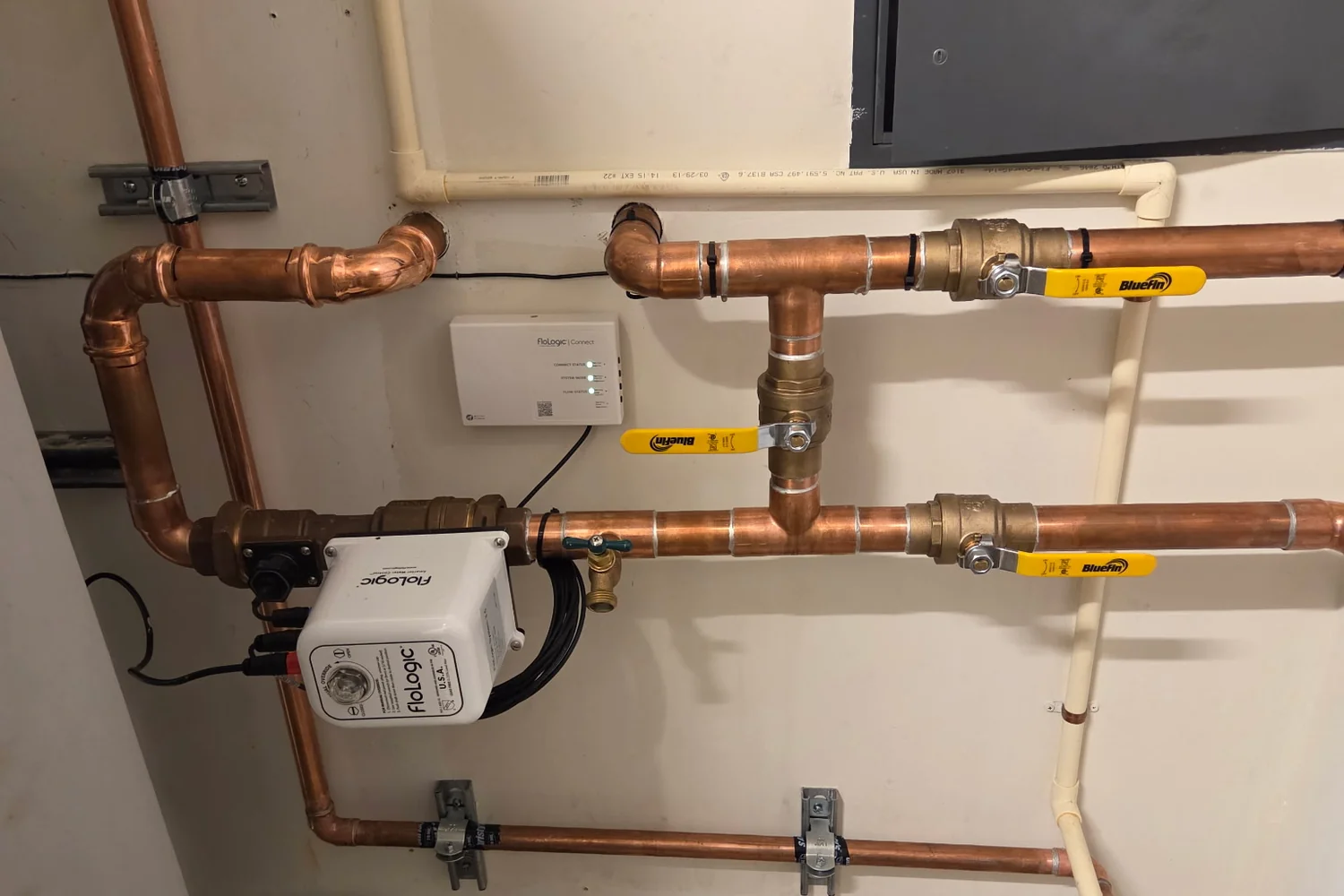
Most Orange County homeowners installing a smart water shutoff grab whichever brand is easiest to find and hope it works. This guide is for the buyer who wants to know what they are actually signing up for. That includes two things a product page will never mention: whether your water main has a nearby power outlet, and what the system will need from you over the next ten years.
Key Takeaways
- Whole-home smart shutoffs need an AC outlet within 6–15 feet of your water main. YoLink is the only battery-only exception.
- Moen Flo's turbine can foul in Orange County hard water (12–18 gpg) within 3–5 years. FloLogic, Phyn Plus, and Frizzlife avoid this.
- Three categories: flow-monitors catch drips inside walls, sensor-plus-valve kits catch bursts on the floor, wet-probes are local alarms only.
- Multiple California carriers now require a smart shutoff on higher-value or older-home policies — Farmers since 2022, State Farm since 2023, Mercury since May 2026.
On this page
- Do I need an electrical outlet at my water main?
- Before you buy: a five-point checklist
- What are the three types of automatic water shutoff valves?
- Comparison Table 1: features and specs
- The five systems most Orange County homeowners choose from
- A few others worth knowing about
- What maintenance does a smart water shutoff need over time?
- Comparison Table 2: maintenance realities
- How do smart water shutoff valves detect leaks?
- How do I choose the right smart water shutoff for my home?
- Do California insurance companies require a smart water shutoff?
- Frequently asked questions
Do I need an electrical outlet at my water main?
You need an electrical outlet at your water main for every whole-home smart water shutoff except YoLink. Moen Flo, Phyn Plus, FloLogic, Resideo L5, StreamLabs, and Frizzlife all install to the valve and need AC power there. YoLink is the only exception — its valve runs on AA batteries. See Table 1 below for per-brand cord lengths.
Most articles about smart water shutoffs are written to sell you a specific product. This one is written to give you the facts you need to make the right call for your specific situation — before you spend your money and your time.
Two things worth knowing beyond what the chart shows. Moen sells a waterproof extension cord as a separate accessory, which tells you outlets often aren't near mains — but an extension cord is a temporary fix, not a permanent one, and California electrical code and most local jurisdictions do not allow a permanent appliance to be powered off one. Check with your electrician or your city's building department before you rely on it long-term.
And YoLink's hub still needs AC power even though the valve doesn't, so a storm can take the app and cloud alerts offline unless the hub is on a UPS (battery backup, uninterruptible power supply) — the valve itself keeps working locally on its batteries.
Walk out to your main shutoff and look. If there's an outlet within about ten feet, you have every option on the table. If not, budget for an electrician or pick YoLink.
Before you buy: a five-point checklist
Before buying a smart water shutoff for your Orange County home, walk out to your water main and check these five things: outlet availability, water hardness, main line size, insurance requirements, and your maintenance comfort. If any answer is "no" or "not sure," get answers before you swipe the card.
1. Is there an AC outlet within ten feet of your water main?
For every system on this list except YoLink, this is a requirement. If the answer is no, budget for an electrician.
Phyn Plus 2nd gen requires the outlet within eleven feet; Moen Flo, FloLogic, Resideo L5, and Frizzlife all need one within reach. See per-brand cord lengths in Table 1 below →
2. Do you know your city's water hardness?
In Huntington Beach, Newport Beach, Fountain Valley, and Garden Grove, tap water runs 12 to 18 grains per gallon — hard enough that a turbine-based device (Moen Flo) can eventually need cleaning. Costa Mesa runs closer to 6.4 gpg because Mesa Water District draws mostly from local groundwater.
FloLogic, Phyn Plus, and Frizzlife use ultrasonic or full-port designs that avoid this problem. More on hard-water maintenance below →
3. What size is your main line?
Most residential mains are 3/4" or 1". If yours is 1.5" or 2" (larger homes, some multi-family properties), your options narrow to FloLogic, StreamLabs, WaterCop, or Watts. See pipe sizes per brand in Table 1 →
4. Does your homeowners policy require a shutoff, or offer a discount for one?
Mercury Insurance has required one on many California policies since May 29, 2026. Chubb, PURE, Vault, Liberty Mutual, and Farmers offer discounts.
Call your agent before you buy — some carriers steer you toward specific approved devices, and the requirements are policy-specific. Insurance section below →
5. How comfortable are you with maintenance?
Sealed systems (Phyn Plus) demand the least. YoLink needs battery changes on a schedule.
Moen Flo may need periodic turbine cleaning in hard water. FloLogic asks for a semi-annual owner test and a backup battery swap every three years. Match the system to how much you want to do.
What are the three types of automatic water shutoff valves?
Automatic water shutoff valves come in three types. Type 1 watches water pressure and flow around the clock, catching even tiny drips inside your walls. Type 2 waits for a floor sensor to touch water, then closes the main valve. Type 3 is a basic sensor with a loud siren — no phone, no app, no smart features.
Not every shutoff device does the same job. A homeowner comparing prices online can end up looking at a $150 sensor kit next to a $600 whole-home monitor and thinking they do the same thing. They don't. Pick the type that fits your worry before you pick a brand.
Type 1: Whole-home flow and pressure monitors with a built-in valve. These install right on the main water line and watch water flow and pressure continuously. They also track temperature to catch freeze warnings. Once a night, most of them run a quiet self-test: the valve closes for a few minutes and the electronics check whether the pressure inside your pipes stays steady.
If it drops, that means water is escaping somewhere, and the app tells you. This is the only type that catches a slow leak inside a wall — or a hidden slab leak under your slab — before the drywall starts to bulge or your flooring buckles. Catching those early matters for your insurance too: many policies limit or deny coverage for water damage that went undetected for weeks or months, treating it as gradual seepage or a maintenance issue rather than a sudden loss.
Brands in this group: FloLogic, Moen Flo, Phyn Plus, StreamLabs Control, and Frizzlife LP365.
Type 2: Motorized main-line valve plus wet floor sensors. A small puck sits on the floor near your water heater, washing machine, or under a sink. When water touches the two metal dots on the bottom of the puck, it radios the main valve to close. These cost less and go in faster than Type 1, and they catch a burst washing-machine hose or a leaking water-heater tank right away.
But they will not catch a slow drip inside a wall that never reaches the floor. Brands in this group: YoLink, Guardian by Elexa, Resideo/Honeywell L5, WaterCop, and Watts Leak Defense System.
Type 3: Simple wet-sensor shutoff with no phone or app. Same basic idea as Type 2, but without WiFi, without an app, and without any way to alert your phone. The controller makes a loud siren and closes the valve, and that's it. It only helps if someone is home to hear the siren.
Brands in this group: iSpring's LS43 and LS43WL.
Ask yourself: do you want the system to catch water you cannot see (Type 1), a burst hose you'll walk into (Type 2), or a wet-sensor siren while someone's home to hear it (Type 3)?
Comparison Table 1: features and specs
About the prices below: the numbers shown are manufacturer suggested retail (MSRP), or the most common price we found online at the time this article was written. Actual prices move around — verify with the retailer before you buy. Install labor is a separate line item and is not included in these hardware prices.
The table covers only actively-sold models. LeakSmart is included because homeowners still ask about it, but it has been discontinued.
| Product | Category | Pipe sizes | Power | Warranty | Hardware price |
|---|---|---|---|---|---|
| FloLogic | 1 (flow + full-port valve) | 1", 1.5", 2" | 110V AC + AGM battery backup | 5 yr | ~$2,190 (1") – $3,340 (2") |
| Moen Flo | 1 (flow + nightly test) | 3/4", 1", 1-1/4" | AC, ~10 ft cord | 1 yr (5 with FloProtect) | ~$550–$625 |
| Phyn Plus 2 | 1 (240 Hz pressure + ultrasonic) | Fits ≤ 1-1/4" main | AC, 11 ft cord | 2 yr | ~$539–$580 |
| StreamLabs Control | 1 (ultrasonic only) | 3/4" to 2" | AC; 9V for manual override | 1–2 yr (sources conflict) | ~$999–$1,449 |
| Frizzlife LP365 | 1 (ultrasonic flow) | 3/4"x1", 1-1/4"x1" | AC, 6.5 ft cord + Li-ion backup | Not published | ~$330–$430 |
| YoLink (Valve + Hub) | 2 (sensor + LoRa radio) | 1/2" to 2" | 4 AA at valve (2+ yr) or 12V plug-in | Not published | ~$299 kit |
| Guardian by Elexa | 2 (clamp-on actuator) | Fits 1/2"–1-1/4" existing valves | 12V DC, 10 ft cord, optional battery | Not published | ~$399 kit |
| Resideo/Honeywell L5 | 2 (inline motorized ball) | 1/2" to 1-1/4" NPT | 15V DC, 10 ft cord | 5 yr | ~$242 (1") |
| WaterCop Classic | 2 (commercial-grade inline) | 1/2" to 1-1/4" | 115V AC, 8 ft cord | Not published | ~$820–$1,234 |
| Watts Leak Defense System | 2 (premium whole-home) | 3/4" up to 4" | Not published | Not published | $2,351–$5,006 |
| iSpring LS43 / LS43WL | 3 (local wet-probe) | 3/4" or 1" MNPT | 5V AC; short cord | 1 yr | ~$150–$220 |
| LeakSmart | Discontinued 2024. Parent company Waxman shut the brand down and the cloud service is offline. Skip. | ||||
WiFi note: every WiFi-connected device on this list uses 2.4 GHz (not 5 GHz), and most integrate with Amazon Alexa and Google Home. Apple HomeKit support varies. LoRa (long-range low-power radio) is the wireless standard YoLink uses to keep its sensor talking to its valve even during a WiFi or internet outage.
The five systems most Orange County homeowners choose from
Five smart water shutoff systems cover the practical choice for most Orange County homes: FloLogic, Moen Flo, Phyn Plus 2nd Gen, YoLink, and Resideo/Honeywell L5. They span from the budget/DIY tier at one end to the professional-grade installer-only tier at the other. Here is the honest read on each.

FloLogic Smart Water Control (the professional-grade tier)
FloLogic is what plumbers install on the big houses — the ones where a slow leak behind a wall doesn't just wreck drywall, it wrecks stone, cabinetry, and hardwoods that took months to source. Not sold in stores; it ships through the trade. The main valve is a true full-port design, machined in North Carolina — no turbine spinning inside the water line, so nothing fouls with the calcium buildup common in most Orange County water.
Home insurance carriers most often prefer it for higher-value policies. See the tables above and below for warranty, power, and price. Trade-off: no native Alexa, Google Home, or Apple HomeKit integration.

Moen Flo (the default consumer choice)
Moen Flo is the default consumer choice. It watches flow and pressure 24/7 and runs a nightly self-test that can catch a one-drop-per-minute leak, and it's the brand insurance carriers recognize most often. Trade-off: an internal turbine that can foul with calcium scale in Orange County's hard water — Moen sells replacement turbines because owners hit this at three to five years.

Phyn Plus 2nd Gen (the sealed-unit sensor tech)
Phyn Plus has the tightest detection sensitivity in the category — down to 0.01 gpm, using water-pressure signatures sampled 240 times per second plus ultrasonic flow. No turbine to foul in hard water. Trade-off: the same tight sensitivity that catches a slab leak will also flag a slowly running toilet flapper — helpful, but expect alerts for small leaks you might otherwise ignore. Also, the unit is sealed — Phyn says it should not be disassembled or serviced, so customer support is your only path if it fails.

YoLink (the budget/DIY tier)
YoLink is the budget/DIY tier. Battery-only at the valve means no outlet required — the only whole-home option that skips the electrician. Long-range LoRa radio pairs the sensor directly to the valve, so a leak triggers a shutoff even without internet. Trade-off: sensor-triggered only (no slow-drip detection inside walls), and the AC-powered hub goes dark in a power outage unless you plug it into a battery backup unit (called a UPS — uninterruptible power supply).

Resideo (Honeywell) L5 (the value inline valve)
Resideo L5 is the value pick among inline motorized valves. It supports up to 100 wired or 30 wireless sensors, which is unusual at this price. Trade-off: no pressure-signature detection like Phyn, no nightly self-test like Moen Flo — it's a solid valve, not a smart flow analyzer.
A few worth mentioning that most homeowners skip
Six more smart water shutoff systems come up in shopping searches but do not make the top-five list for most Orange County homes: Guardian by Elexa, StreamLabs Control, Watts Leak Defense System, Frizzlife LP365, iSpring LS43, and LeakSmart. Each has a specific reason it is not a first-choice recommendation for the typical single-family home.
Guardian by Elexa
Consumer Reports' pick for best DIY system. It is a clamp-on actuator that grabs an existing 1/4-turn ball valve — no pipe cutting — and pairs with long-range RF sensor pucks that carry vibration, water, and temperature sensing. Berkshire Hathaway GUARD includes Guardian in its homeowner-policy loss-prevention program. Kit is about $399 direct from Elexa.
StreamLabs Control
Owned by Chubb since 2021. Ultrasonic flow measurement, fits pipes up to 2" (the widest range in the consumer category), $999 to $1,449 hardware only. The problem: it is frequently out of stock at the manufacturer's own store, one distributor lists it as discontinued, and the product carries almost no independent review history at retail. Verify availability before you commit.
Watts Leak Defense System
The premium option for very large homes if FloLogic is not a fit. Fits pipe up to 4", supports 15 wireless sensor pucks, has a wall-mount RF control panel that keeps working during an internet outage. Hardware runs $2,351 to $5,006. Right answer for a 6,000-square-foot home; overkill for a typical Orange County single-family house.
Frizzlife LP365
Newer entry from a brand better known for water filtration. Ultrasonic flow monitoring plus a shutoff valve, controlled through the Tuya Smart Life app. Frizzlife is headquartered in Denver with a US warehouse in South El Monte, roughly 30 miles north of Orange County.
Products are manufactured in China. Priced between $330 and $430. Independent review data is thinner than for Moen Flo or Phyn, but Smart Home Explorer rated the LP365 7.5 out of 10 ("Recommended") in a hands-on test.
iSpring LS43 and LS43WL
Local wet-probe shutoffs at $150 to $220. No WiFi, no app, no phone alerts. If you are going to be home when the water heater lets go and you just want a valve to close the moment a sensor gets wet, this is honest hardware at an honest price. If you travel, own a rental, or want to know about a slow drip inside a wall, look at Category 1 instead.
LeakSmart (a warning, not a recommendation)
LeakSmart was a Zigbee-based shutoff sold widely at big-box retail in the late 2010s. Parent company Waxman shut the brand down in 2024, killed the cloud service, and there's an open class-action investigation. If you have LeakSmart hardware installed today, the WiFi version is bricked and the Zigbee valves and sensors will only keep working if you can move them onto a different Zigbee hub like SmartThings. If you're an existing LeakSmart owner, give us a call — we help homeowners retire dead-brand hardware without ripping out the pipe work.
What maintenance does a smart water shutoff need over time?
A smart water shutoff needs different maintenance depending on the brand. FloLogic auto-exercises every two weeks and needs a backup battery every three years. Moen Flo runs daily tests but its turbine can foul in hard water at three to five years.
Phyn Plus is sealed — no service. YoLink needs sensor and valve battery changes every one to five years.
Now that the shortlist is narrowing, this is where the brands actually separate over time. Every system needs something from the owner after the plumber leaves, and the devices in this guide fall into three maintenance profiles.
Flow-monitors with a spinning turbine (Moen Flo) need occasional cleaning as hard-water scale builds up on the sensor magnets. A real owner's tutorial documents a Moen Flo turbine failure at about three and a half years in a hard-water area — Moen now sells replacement turbines because the failure is common enough to have a part number. In most Orange County water, this is a real long-term issue.
Verified hardness averages 12 grains per gallon in Huntington Beach, 13 in Newport Beach, 12 to 15 in Fountain Valley, and roughly 18 in Garden Grove. Costa Mesa is the outlier at 6.4 grains per gallon because Mesa Water District runs mostly on local groundwater from a cleaner aquifer.
Flow-monitors without a turbine (FloLogic full-port, Phyn Plus ultrasonic, Frizzlife ultrasonic) do not have the fouling problem, but each still needs something. FloLogic auto-exercises its valve every two weeks, asks the owner to run a semi-annual test, and needs a backup battery swap every three years. Phyn Plus is fully sealed — no owner or plumber service; if it acts up, Phyn customer support is your only path.
Frizzlife runs a rechargeable Li-ion backup that gives it roughly four to six months of standby when the power drops, and Frizzlife has not published a service schedule.
Sensor-triggered systems (YoLink, LeakSmart, Guardian) need battery changes on the sensor pucks (roughly one to five years depending on brand and battery type), fresh batteries in the valve controller when applicable, and, for hub-based systems, an uninterruptible power supply on the hub if you do not want a power outage to take the whole system offline.
If you are comparing brands over a five-to-ten-year window, this is the difference between a system that works quietly in the background and one that eventually makes you reach for a wrench.
Comparison Table 2: maintenance realities
This table maps to the maintenance profiles above — moving parts (turbine yes/no), battery backup at the valve, and whether the system exercises itself.
| Product | Moving parts in water path | Battery backup at valve | Auto valve exercise |
|---|---|---|---|
| FloLogic | No — full-port valve, external flow sensor | Yes — built-in AGM battery, ~3 yr life | Yes — every 2 weeks |
| Moen Flo | Yes — turbine can foul in hard water | Recalled 2023 — no current option | No — daily health test only |
| Phyn Plus 2 | No — ultrasonic + pressure sensing | Not published | Not published |
| StreamLabs Control | No — ultrasonic | 9V for manual override only | Not published |
| Frizzlife LP365 | No — ultrasonic | Rechargeable Li-ion (~4–6 mo standby) | Not published |
| YoLink (Valve + Hub) | Motorized ball valve | Batteries are the power (2–5 yr) | Not published |
| Guardian by Elexa | Clamp-on actuator (no cutting) | Optional battery | Not published |
| Resideo/Honeywell L5 | Motorized ball valve | Not published | Not published |
| WaterCop Classic | Motorized ball valve | Not published | Not published |
| Watts Leak Defense | Motorized ball valve | Not published | Not published |
| iSpring LS43 | Motorized valve | No | No |
"Auto valve exercise" means the system automatically closes and reopens the valve on a schedule, which prevents the valve from seizing over time. Valves that never move can eventually stick closed or open, especially in hard water.
How do smart water shutoff valves detect leaks?
Smart water shutoff valves detect leaks in six main ways: ultrasonic flow measurement, full-port flow sensing, pressure-signature fingerprinting, nightly pressure decay testing, mechanical turbine flow measurement, and wet-probe conductivity sensors. Most whole-home flow-monitor systems combine several of these methods. The technique matters because some (like turbines) can fail in hard water while others (ultrasonic, full-port) don't.
Here is each detection method in language a homeowner can use to read a spec sheet without needing a plumbing degree.
Ultrasonic flow (time-of-flight)
Two small transducers sit on opposite sides of the pipe and fire quick ultrasound pulses at each other — one aimed upstream, one aimed downstream. When water is flowing, the downstream pulse arrives a little faster because it's riding the current. The unit measures the tiny time difference and calculates the flow rate.
Because there are no moving parts, nothing wears out or fouls with sediment. StreamLabs Control, Phyn Plus, and Frizzlife LP365 all use this method.
Full-port valve with flow sensing (FloLogic)
A true full-port valve is a ball valve with an opening as large as the pipe it sits on. Water flows straight through without a restriction, and there is nothing spinning inside the water path to catch calcium or sediment. FloLogic pairs this valve with an electronic flow sensor outside the water path, so it gets flow-based detection down to half an ounce per minute without the wear parts that turbine designs have.
Pressure signature (fixture fingerprinting)
Every fixture in your house makes a tiny pressure ripple in the water column when it opens or closes — a toilet refill, a shower valve, a hose bib. Phyn samples pressure 240 times per second and learns each fixture's individual signature. When the system sees a pattern it doesn't recognize, or a familiar pattern that runs longer than it should (a hose bib left on all night), it flags a possible leak.
Nightly pressure decay test
Once a night when the house is quiet, the valve closes itself for a few minutes and watches the pressure inside the pipes sit still. In a leak-free system, that pressure should hold rock steady. If it drops even a little, water is escaping somewhere — a leaky toilet fill valve, a pinhole in a wall, or a slab leak hiding under the slab. Moen Flo calls this its MicroLeak test.
Turbine or paddle-wheel flow (mechanical)
A small paddle spins in the water flow. The faster the water moves, the faster the paddle spins, and a magnet on the paddle tells the electronics how many gallons per minute are going through. Simple and cheap, but the paddle has moving parts that can foul with the hard-water scale and sediment common in most of Orange County, or wear out after years of use. Moen Flo uses a turbine.
Wet-probe conductivity (sensor pucks)
Two small metal contacts sit close together on the underside of a sensor puck. When dry, no electricity flows between them. When water bridges the gap, current flows and the circuit trips — the puck sounds its alarm and, if it is paired to a smart valve, signals the valve to close. Cheap, reliable, and immediate, but only fires when water physically touches the puck.
Freeze and temperature sensing
A small thermistor on the valve or the sensor puck watches the surrounding temperature. If the reading drops below a threshold you can usually set in the app, the unit either closes the main automatically or fires a push alert to your phone so you can shut the water off yourself. YoLink's leak sensor lets you set a freeze alarm anywhere from 23°F up to 59°F.
How do I choose the right smart water shutoff for my home?
The right smart water shutoff for your home is decided by three questions: how old the plumbing is and how valuable the finishes above it are, how often you travel or leave the house empty, and whether your insurance carrier already requires or discounts a specific device. Match the system to your home's risk profile, not the highest-spec option on the shelf.
How old is the plumbing, and how much are the finishes worth? If the house has copper lines from the 1960s or 1970s (common in Fullerton, Anaheim, Costa Mesa's older tracts, and inland Orange County), pinhole leaks — including slab leaks under the slab — are the real risk, and a Category 1 flow-monitor is worth the extra money.
If the finishes above those pipes are stone, custom cabinetry, or wide-plank hardwood, FloLogic's premium tier starts to pay for itself the first time it catches a leak that would have destroyed them. For a 1990s tract home on PEX with builder-grade drywall, Moen Flo or Phyn Plus is the right level.
How much time do you spend away from the house? A second home. Business trips every month. Traveling for a wedding.
Renting the house out on Airbnb. The more you are away, the more the phone alerts matter, and the more the automatic shutoff pays for itself. A Category 3 iSpring is not the right answer for a homeowner who travels.
What's your insurance situation? If your homeowners policy is with Mercury, Farmers, State Farm, or The Hanover, you may already be required to install one. If you are with Chubb, PURE, Vault, or another high-net-worth carrier, you are probably eligible for a device discount and possibly a rebate on the hardware itself. Call your agent before you buy to see whether they have a preferred brand list — some carriers steer you toward specific approved devices.
Do California insurance companies require a smart water shutoff?
Multiple California insurance carriers now require a smart water shutoff on qualifying policies. Farmers has required it since 2022 on homes 30+ years old or with $1M+ replacement value. State Farm requires it since February 2023 on $2M–$4M replacement cost policies.
Mercury added the requirement May 29, 2026. Chubb, PURE, Vault, and others offer discounts.
Insurance requirements change and every policy is written to the individual property. Verify your specific situation with your own agent.
Water damage is the biggest non-weather claim category in American homeowners insurance — 27.6% of all homeowners losses in 2022 per the Insurance Information Institute, with an average claim of $13,954. Multiple California carriers have moved from a discount incentive to a hard requirement:
- Farmers (since 2022) — required on California homes over 30 years old with plumbing not updated in 20 years, or homes with $1 million or more of replacement value.
- State Farm (February 2023) — required for California policyholders with $2 million to $4 million in replacement cost.
- The Hanover — required on new standard and high-net-worth policies.
- Mercury (May 29, 2026) — required on homes meeting age and coverage criteria (30+ years in high-risk water zones, 50+ years with $2M+ coverage, or any age with $3M+ coverage). Install must complete before first renewal or the policy is non-renewed. Mercury subsidizes $400 of a Moen Flo install and offers about $100 per year off the premium.
On the discount-only side, Chubb (owns StreamLabs) discounts up to 3% for sensors and up to 8% for a full shutoff, plus 20% off StreamLabs hardware. Vault takes 15% off a Phyn Plus. PURE discounts up to 5%.
Liberty Mutual announced a Moen Flo partnership in April 2025. Discount amounts vary by carrier and by policy.
What California code says. The 2025 California Plumbing Code does not require automatic water shutoffs for residential new construction. Individual Orange County cities can adopt local amendments, so verify with your city's building department if you're building or doing a major remodel.
Frequently asked questions
Is a smart water shutoff actually worth the money?
A smart water shutoff is worth it for homes where a hidden leak would cost more than the hardware plus install — most Orange County single-family homes fit that math. The Insurance Information Institute reports the average water damage claim runs $13,954, and the device pays for itself the first time it catches a leak that would have destroyed drywall or hardwood.
How long do smart water shutoff valves last before they need replacement?
Smart water shutoff valves typically last 8 to 15 years depending on brand and water conditions. FloLogic's full-port valve has no moving parts in the water path and holds up longest. Moen Flo's turbine can foul in hard water at three to five years and needs a replacement turbine service call. Phyn Plus and Frizzlife use ultrasonic sensing with no wearing parts.
Does a smart water shutoff work with a water softener or whole-house filter?
A smart water shutoff works with a whole-house filter or water softener. Install the shutoff upstream of the filter or softener — closer to the water main — so a leak in either piece of equipment triggers the shutoff. Every major brand's install guide covers this configuration; check the manufacturer manual for the specific plumbing order your device requires.
Can I install a smart water shutoff valve myself, or do I need a plumber?
Most inline smart water shutoffs need a plumber, because the valve is cut into the main line on the house side of the meter. Clamp-on models like YoLink's EVO and Guardian by Elexa's actuator grab an existing ball valve without cutting pipe — a homeowner with basic tools can install one in an afternoon.
What happens if the power or internet goes out?
Most inline smart water shutoffs stay open when power drops. FloLogic is the exception — a built-in sealed lead-acid battery keeps it monitoring through most outages. Moen Flo's battery backup accessory was recalled in 2023 and is no longer available. YoLink's valve runs on AA batteries, but its hub is AC-only, so cloud alerts stop when the hub loses power.
Will a smart water shutoff close on me during a long shower or when guests are over?
Flow-monitors like Moen Flo and Phyn learn your household's usage patterns and can flag unusual flow — a 40-minute guest shower, an irrigation cycle you forgot to schedule. Every major app has an "away mode" or event override you can turn on beforehand to prevent a false shutoff.
Does an automatic water shutoff catch slow leaks or only burst pipes?
Only some smart water shutoffs catch slow leaks. Flow-monitors with a nightly pressure-decay test — Moen Flo, Phyn Plus, and FloLogic — can catch a slow drip in a wall or a running toilet. Sensor-triggered systems like YoLink, Guardian, and Resideo L5 only fire when a wet sensor is touched by water.
Do I need a separate WiFi network for these?
A separate network is not required, but every WiFi-enabled smart water shutoff uses 2.4 GHz only, not 5 GHz. Modern mesh routers that broadcast both bands under one name can confuse setup. Splitting the 2.4 GHz band into its own network temporarily is the usual fix.
How much does professional install add to the hardware price?
Smart water shutoff install cost depends on where the main shutoff is, whether a wall or slab has to be opened, and whether the plumber needs to add a bypass. A qualified plumber gives a written quote before starting, so the price is fixed. Call Professional Plumbing for a quote at your Orange County address.
What to do next
- First, walk out to your water main and check whether there is a power outlet within ten feet. If not, an electrician is part of the budget.
- Next, look at your insurance declarations page for anything about a required or discounted water shutoff device. If you have Mercury, check whether the May 2026 rule applies to your policy.
- Then pick a category based on how the house is built, how often you are home, and how much maintenance you are willing to do.
- Finally, if you want it professionally installed, get a written quote before any work starts.
If you'd like us to install it
If you'd like us to come out and take a look, our written estimates are free — no charge for a plumber to see the job and price it on site. The install price is quoted in writing before any work starts. We give a two-hour window and call when the truck is on the way.
If your situation is an emergency — a burst line, an active leak — we are available 24 hours a day, every day of the year, though after-hours visits are at overtime rates.
If the shutoff you're looking at turns out to be a bad fit for your setup, we'll tell you that. If your plumbing has a bigger problem that a shutoff won't solve — a slow leak already inside a wall, an old galvanized main line ready to give up — we'll walk you through the options and the cost on each one.
Have a question?
If you're trying to understand whether an automatic water shutoff makes sense at your house, weighing which brand fits your setup, or working through a DIY install and hit a snag, you're welcome to call. The number is (714) 964-3519.
Day or night, you'll reach me or my sister Liz. After hours and it can wait? Feel free to book online anytime.
There is no obligation to schedule service. We like talking to people in our community, and sometimes a phone call answers what an article cannot.
William J. Horsky Jr.
Owner, Professional Plumbing, Inc.
About the author
Professional Plumbing, Inc. Founded and owned by William J. Horsky Jr., 1985.
CSLB 517514 C-36, held since 1987. Incorporated 2001. Offices in Fountain Valley, Garden Grove, Huntington Beach, Costa Mesa, and Newport Beach.
Serves homeowners and businesses across Orange County.
This page was updated on October 12, 2026.
Serving Orange County since 1985.