
How to Choose the Best Tankless Water Heater in Orange County
How to Choose the Best Tankless Water Heater in Orange County
A plumber’s honest, brand-by-brand guide for OC homes — from the owner who’s run tankless at his own house for more than 25 years, across three units.
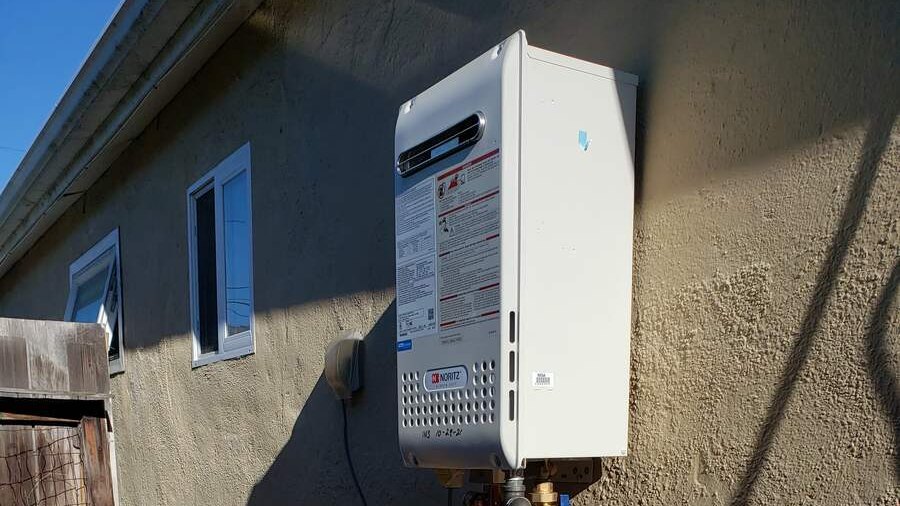
The best tankless water heater for an Orange County home is a condensing gas unit from Noritz, Rinnai, or Navien — sized to how many fixtures run hot at once, matched to a gas line big enough to feed it, and picked for how it holds up in local hard water. Which of those three brands is right for you depends on how you live in the house, how long you plan to stay, and what’s already behind your walls. I’ve been installing water heaters in Orange County since 1985. I ran my first tankless at my own house for almost two decades — way past its warranty and still going when I finally swapped it. The two units I’ve been running since have another 6 or 7 years on them and are still going strong. This guide is what I’d tell a friend if they called me.
What this page covers
- The three brands we install — Noritz, Rinnai, and Navien — and where each one fits
- Whether a tankless is actually worth it for your home, or whether a tank is the smarter call
- Condensing vs non-condensing, and why we pick condensing on 90-95% of OC jobs
- Which brand suits which kind of OC home — coastal, inland, large family, ADU, long-term owner
- The real downsides, the maintenance that keeps a tankless alive 20 years, and the mistakes that kill one early
- Three real Orange County installs — one cautionary, one creative rescue, one Garden Grove family
Jump to a section
- The best tankless for an OC home
- Is a tankless worth it in Orange County?
- Condensing vs non-condensing
- Noritz, Rinnai, Navien — brand deep dive
- Which brand for which OC home
- The real downsides of a tankless
- How a tankless water heater works
- How long tankless water heaters last in OC
- Three real Orange County installs
- Why a tankless needs annual maintenance in OC
- Replacing a 40- or 50-gallon tank with a tankless
- What NOT to do when choosing a tankless
- Frequently asked questions
The best tankless water heater for an Orange County home
The best tankless water heater for an OC home is a condensing gas unit from one of the three brands we install — Noritz, Rinnai, or Navien. Stick with the big three and you’re pretty much going to be okay. All three have caught up to each other on the technology that used to separate them, so the honest question isn’t “which brand ranks number one?” It’s “which of the three fits your specific home?”
Our default is the Noritz NRC 98, in either the outdoor or the direct-vent version. It gives most Orange County homes enough hot water to run two showers at once without struggling. From there, the right pick shifts based on your household size, where you live in the county, whether you want built-in recirculation, and how long you plan to stay in the home. All of that is covered in the sections below.
We don’t sell Takagi, Bosch, or Rheem. Not because they’re bad — because we’ve heard of more issues with them and we prefer to install only the units we’ve personally handled, put in, and stood behind for years. That’s a choice about what we’re willing to warranty, not a comment on the whole industry.
Is a tankless water heater worth it in Orange County?
For most Orange County homes, yes. I’ve run tankless at my own house for more than 25 years, across three units. The first one had a 12-year heat exchanger warranty and I got almost two decades out of it — well past warranty and still going strong when I finally swapped. When the manufacturer offered me a cheap deal on their newer units, I put in two more. Those two have been running about 6 or 7 years now. That’s my personal answer to “is this worth it”: I’ve had one, I’ve had two, I plan to have them after this. The DOE puts tankless lifespan at more than 20 years, and I’ve lived past that number already.
The economics look like this. The first tankless install is the most expensive changeout you’ll do — you’re paying for the gas line upsize and the venting on top of the unit itself. But by year 10, when your first tank has failed and needs replacing, that tank replacement costs roughly the same as the original tankless install. Meanwhile the tankless is only halfway through its life. By year 20 the tankless gets swapped for a second unit that goes in fast because the plumbing is already there — and it costs about half to three quarters of what a new tank would cost you. Tanks in OC water last 8 to 10 years, and 10 is at the top end. Over 20 years you buy three tanks or two tanklesses, and the second tankless install is the cheapest of the four.
The convenience is the part everyone talks about — nobody in the house ever runs out. Guests over, teenagers back-to-back, laundry running with a shower going, it’s the same. But we don’t push tankless on convenience alone. We look at whether the cost is worth it, not whether the convenience is worth it. When the numbers don’t work — a home on a half-inch gas line with a long run to the meter, no easy exterior wall, no electrical in the water heater closet, needs a new recirc setup on top of all that — we tell the customer to stay with a tank. Sometimes a tank plus a recirculation pump gives them 90% of what they want at a fraction of the install cost.
Where a tankless clearly wins: teenagers, back-to-back-to-back showers, a household of four or more, or an owner who never wants to run out again. A Garden Grove family we installed for a few years back (details in the case studies below) went from morning fights over the last hot shower to peaceful mornings. The father told us it was the best money he’d spent on the house.
Should I get a condensing or non-condensing tankless?
For most Orange County homes, a condensing tankless is the right choice. It vents in inexpensive PVC instead of expensive Category III stainless, and the higher efficiency (roughly 0.90 to 0.98 UEF) means less gas over the life of the unit. We install condensing on about 90 to 95% of OC jobs.
The place non-condensing still fits is a straight outdoor swap where venting isn’t a factor at all — an outdoor unit doesn’t need any venting — or a like-for-like replacement of an existing non-condensing unit where the flue is already there.
One trap to watch for on older OC homes with cast iron drain lines: don’t terminate a condensing unit’s condensate drain at the end of a dry cast iron pipe where it can drip and sit. Condensate is acidic. It’ll eat the bottom of that pipe out. Route it into a drain that gets other liquid flow — a washing machine drain, for example — so it stays diluted.
Noritz, Rinnai, Navien — the three brands we install, in depth
The big three tankless brands — Noritz, Rinnai, and Navien — are the ones we install and stand behind. Between them, I don’t have anything I’m good enough technically or trained enough to know there’s a major difference. All three have solid stainless heat exchangers now, all three have long warranties, and all three make units that will run 20 years in Orange County water with proper maintenance. Where they differ is character, not quality.
| Brand | Best for | Heat exchanger | Built-in recirc? | Heat exchanger warranty | Our OC rating |
|---|---|---|---|---|---|
| Noritz (our house default) | Fast parts pickup, longest warranty on the EZ Series | Stainless (EZ Series) or copper (standard) | No — takes an add-on pump | 25 years on EZ Series stainless; 12 years standard | ★★★★★ |
| Rinnai | Install, set, and leave it alone | Stainless on newer models; copper on some legacy lines | No — takes an add-on pump; Rinnai makes its own scale filter | 15 years across the lineup | ★★★★★ |
| Navien | Complex homes — multi-zone, multi-pump, boiler-room applications, or when you want recirc from day one | Dual stainless | Yes — ComfortFlow built-in pump and buffer tank | 15 years | ★★★★★ |
Noritz — our house default
Noritz is what we install most. Personally, I went through Noritz’s factory training and I liked how their units came apart in a way that made service and repair straightforward — every screw and fitting had a reason and a place. The other two brands have caught up on serviceability since then. Today, the real reason we default to Noritz is closer to home: Noritz’s warehouse is in Fountain Valley, the same city as our shop. If a part goes bad, we can pick it up the same day.
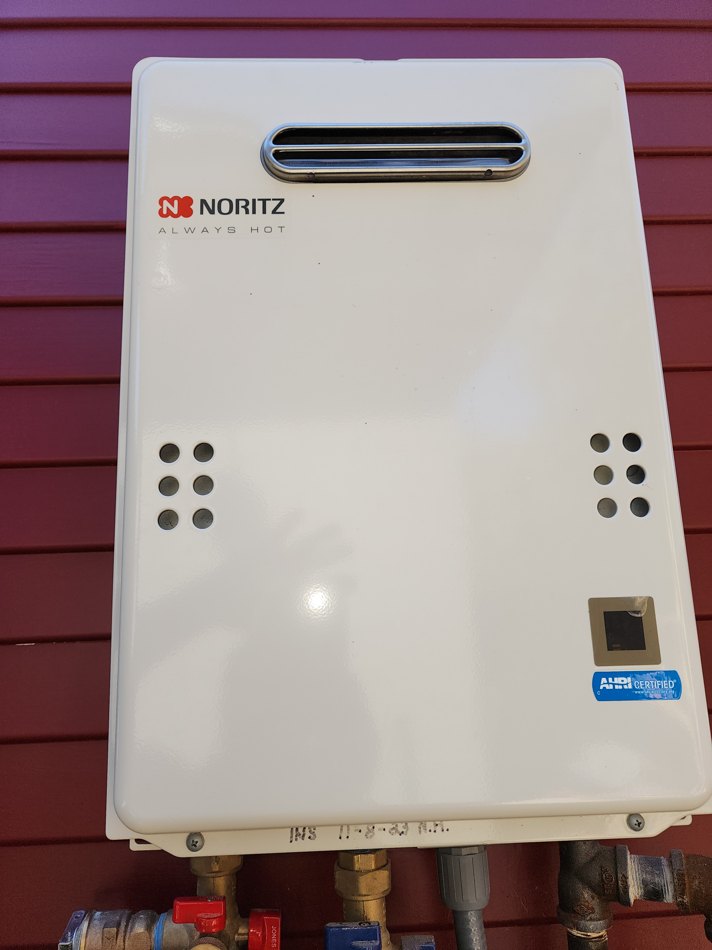
Our most-installed Noritz is the NRC 98, in either the outdoor or the direct-vent version. It handles two simultaneous showers in most OC homes. For long-term owners we step up to the EZ Series (EZ98, EZ111) because of the 25-year heat exchanger warranty — verified against Noritz’s own product documentation, announced in 2019 and still current. That’s the longest warranty in the tankless industry, and it makes the EZ Series the right pick for anyone planning to stay in their home 15+ years.
One thing that trips up other installers on the EZ Series: Noritz technically allows a 1/2-inch gas line on some EZ configurations, but the guidelines are strict — developed length, elbow count, and BTU demand all have to line up exactly. Miss any of them and you starve the unit. We treat “1/2 inch is allowed” as “1/2 inch might work if every condition is met” — and we usually go up to 3/4 inch anyway.
Pre-filter recommendation: unless the home already has a whole-house water softener or filtration system, we suggest a pre-filter on any tankless install. In OC water it extends heat exchanger life and reduces flush frequency.
Rinnai — install, set, leave it alone
Chris, our lead water heater tech, is our Rinnai guru — he’s been installing Rinnai primarily for the last three years. Chris is on the younger side of the crew, well-trained specifically on water heaters and tankless, and more comfortable in the tech than some of us older plumbers. His summary of Rinnai: “Plug it in, start it up, 99% of the time it starts right up.” Rinnai’s out-of-the-box startup is the cleanest of the three. Noritz sometimes needs a couple of settings dialed in before the first firing; Rinnai typically doesn’t. For a customer who wants a low-fuss install and a manufacturer with wide parts availability across North America, Rinnai is the pick.
Rinnai also makes their own in-line scale filter — a cartridge designed to catch hard-water solids before they reach the heat exchanger. Because Rinnai makes both the tankless and the filter, the two are covered as one warranted system. The filter cartridges need changing based on how much hot water the household uses (more showers, longer showers, more people = faster cartridge cycles). In OC water, this pairing works well.
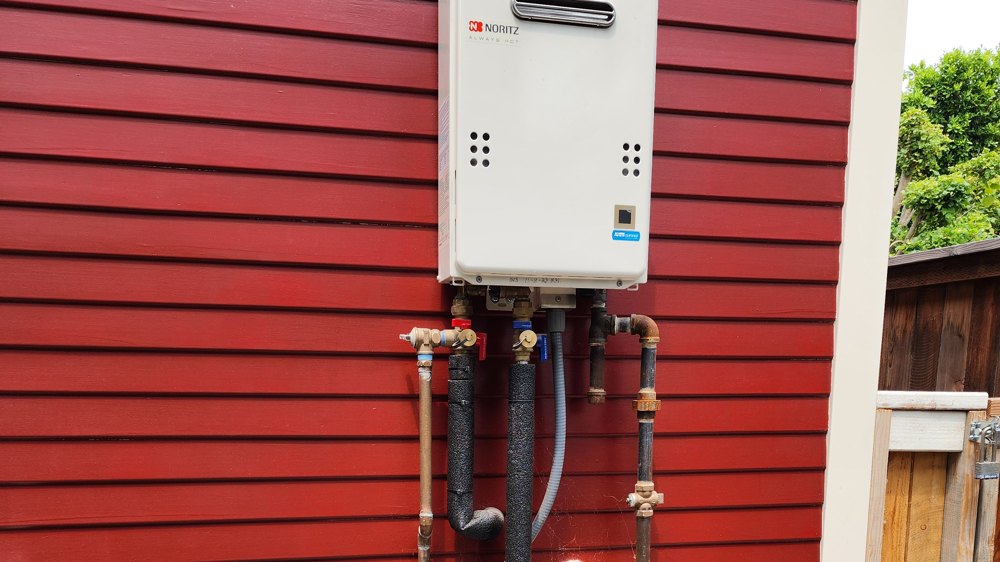
Heat exchanger material matters here. Rinnai’s newer models use stainless heat exchangers rated for 15 years — those will run 20+ years in OC water with annual descaling. Their older copper models transfer heat faster but last less time: 10 to 12 years, maybe 15 in soft water. If you’re picking between a Rinnai copper model and a Rinnai stainless, spend the extra for stainless.
Navien — the tech-forward pick for complex homes
Navien is more tech-friendly than the other two. More settings, more configurable options, and the built-in ComfortFlow recirculation pump with an integrated buffer tank. If your home has a dedicated return line for recirculation, ComfortFlow uses it directly. If your home doesn’t have a return line, Navien sells the NaviCirc — a thermostatic crossover valve that installs under the farthest fixture and uses the existing cold water line as a virtual return loop. Verified against Navien’s own product documentation: the ComfortFlow pump works with either setup. Without one or the other, though, the pump has nothing to circulate through.
Chris’s take: Navien shines on multi-zone water heating, boiler-room applications, and home-run systems with multiple pumps and zones. His comfort in the deeper settings is part of why we send him on the multi-unit jobs — Navien rewards a tech who reads the manual. That’s the pick when the home is bigger or more complex than average — Newport Coast, Huntington Harbor, Newport Beach custom homes where 2, 3, or even 4 tankless units get networked together to talk to each other and share load.
One practical warning on any tankless recirc setup: insulate the hot water line. If the line runs bare copper across the attic, the water loses so much heat between the unit and the fixture that it arrives cold even with the pump running. It’ll heat back up, but the loss on bare pipe defeats the purpose.
Navien is a South Korean manufacturer (Kyung Dong Navien), with its U.S. subsidiary headquartered in Irvine — about 15 minutes from our office.
Which tankless brand for which Orange County home?
The right tankless brand for your OC home depends on four things: household size, where you live in the county, whether you want built-in recirculation, and how long you plan to stay. The pattern we see most often, by buyer profile:
| Your home / situation | Our recommendation | Why |
|---|---|---|
| Long-term owner staying 15+ years | Noritz EZ Series (stainless) | 25-year heat exchanger warranty — longest in the industry |
| Large single-family home, 4+ people, 3+ baths, back-to-back showers | Two or three smaller units networked together (multi-unit) | Redundancy — if one unit alarms, the other picks up load. Also costs less than one oversized unit for equal or greater capacity. We don’t automatically slam customers into one big expensive unit when two smaller ones work better. |
| Coastal luxury home — Newport Beach, Newport Coast, Huntington Harbor | Multi-unit Navien cascade, or matched multi-unit Noritz/Rinnai | Big homes need networked units. Navien’s tech is friendliest for multi-zone. |
| Inland hard-water home — Fountain Valley, Anaheim, Garden Grove | Noritz EZ Series + pre-filter, IF close to the gas meter | Stainless heat exchanger + 25-year warranty pairs well with hard water. Long gas runs steer us a different direction. |
| Home coming from tank-with-recirc — wants instant hot preserved | Navien with ComfortFlow (uses your existing return line) | Only tankless with built-in pump. Plugs into the return line your tank already used. |
| ADU, in-law unit, small condo, single-bathroom tight closet | Small tankless (not a heat pump) | Heat pump tanks need surrounding air to draw heat from and can’t fit in a closet. Small tankless keeps it simple and gas-efficient. Still needs adequate gas and electrical. |
| “Just tell me the cheapest that works” customer | We show options and let you decide | We’ll walk through what we install, what it costs, and the pros and cons of each. No push. Your call. |
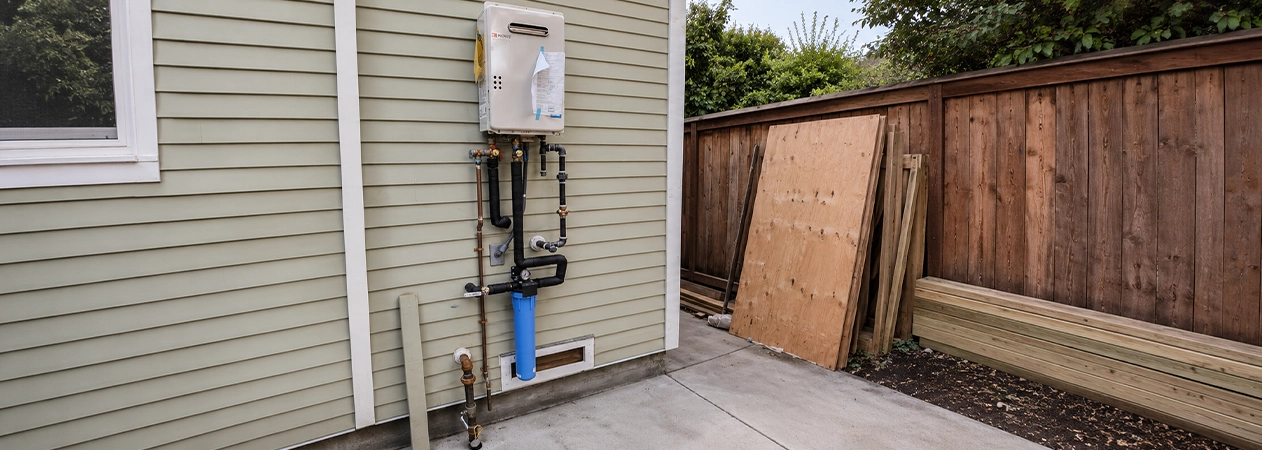
Note on coastal salt air: The competitor buying guides talk up coastal corrosion resistance as if it’s a make-or-break decision for Newport, Huntington, and other coastal OC homes. In 40+ years of installs from Newport to Costa Mesa to Huntington Beach, my honest verdict is that it’s real in principle but a non-issue in practice. I wouldn’t even worry about it. Pick your brand based on the four factors above; leave the salt-air marketing to the buying guides.
What are the real downsides of a tankless water heater?
A tankless water heater has three real downsides. The gas line often has to be upsized on the first install, which is the cost most homeowners don’t see coming. Annual descaling is required in Orange County’s hard water, or the warranty can lapse. And there’s a brief cool-water pause — the “cold water sandwich” — when you turn a tap off and back on within a minute or two. None of these are dealbreakers, but they’re the honest ones.
The gas line surprise is the biggest. A tank water heater draws about 34,000 BTU at a steady, slow rate. A tankless modulates up to 199,000 BTU when it’s firing at full — nearly six times the peak draw. Your existing gas line was sized for the tank, not the tankless. First-time conversions almost always need a line upsize, and if your meter is on the far side of the house, that upsize can be significant.
The cold water sandwich itself is a real, quick moment homeowners notice after install even though they weren’t worried about it before. Here’s what’s actually happening: when you first turn hot water on, you’ll notice the pressure dips for maybe a second. That’s the flow valve inside the tankless slowing the water down deliberately, so it stays in the heat exchanger long enough to heat to temperature while the gas is firing up. It’s brief. It’s not a failure. But it’s real, and people notice.
There’s also the lag issue for homeowners coming from a tank with a recirculation pump. A tankless doesn’t hold hot water in a reservoir — it heats on demand. If your existing plumbing doesn’t have a return line and you don’t add a recirc setup, you’ll wait longer at the fixture for hot water than you did with your tank-plus-recirc. Everybody thinks tankless is instantaneous. The heating is instantaneous. The delivery still has to travel through the pipes.
Straight talk: we don’t push tankless when the numbers don’t work. If you’d need to upsize the gas line AND run new electrical to the closet AND install a recirc system just to make it feel like your old tank+recirc setup — the gas savings won’t offset that cost even on the second changeout. We’ll tell you to stay with a tank.
How does a tankless water heater work?
A tankless water heater’s heat exchanger works a lot like the radiator in your car — in reverse. Instead of blowing cold air through the fins to cool the water inside, a tankless runs a gas flame through the heat exchanger to heat the water rapidly as it flows through. Cold water goes in one end, gets heated on the way through, and comes out hot. No storage tank, no standby loss — the unit sits idle until a tap opens somewhere in the house. When it opens, the flow sensor triggers the burner, the water heats on the way through, and hot water reaches the fixture.
The heat exchanger itself is a bundle of narrow tubes wrapped in the burner’s flame. Water flows through the tubes; heat transfers across the tube wall. That’s why heat exchanger material matters — copper transfers faster but scales up faster too; stainless is a little slower to transfer but lasts much longer, especially in hard water. And it’s why annual descaling matters: scale coating the inside of those tubes is what eventually kills a tankless.
How long do tankless water heaters last in Orange County?
The U.S. Department of Energy puts tankless lifespan at more than 20 years — more than double a tank’s 8 to 10 years. Whether you actually reach 20 years in Orange County depends almost entirely on the annual flush. Skip it, and OC hard water builds scale inside the heat exchanger until the unit fails early or throws fault codes. Keep up with maintenance and 20+ years is realistic — I know because my first tankless at my own house ran almost two decades before I swapped it.
The oldest tankless we’ve serviced that was still running fine was installed in 2007. When we were out for a routine flush earlier this year, it was 19 years old and holding temperature normally. That’s not typical — that’s what’s possible when the install was done right and the maintenance never got skipped.
Three real Orange County tankless installs
Every install teaches us something. Three real ones from our records:
Case #1 — Costa Mesa, near the fairgrounds: the 4.5-year failure
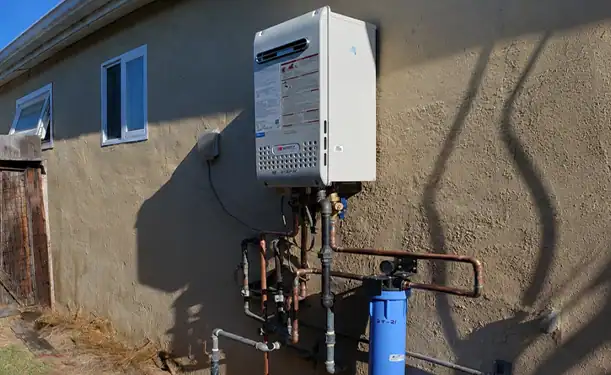
We got called out for no hot water. When we opened the tankless cabinet we saw moisture inside — not a great sign. The problem showed up when we looked at what was feeding the unit: a 1/2-inch flex gas line. Flex doesn’t carry the same gas as hard pipe of the same nominal size, because the corrugation restricts flow. The unit had been starved from day one. Starved combustion flooded the heat exchanger, popped a small leak inside the cabinet, water found the motherboard, and shorted it out. Unit was junk after only 4.5 years.
The lesson: a tankless doesn’t tolerate a shortcut on the gas supply. Not 1/2-inch pipe when it needs 3/4-inch, and definitely not 1/2-inch flex.
Case #2 — Huntington Beach: the contractor who forgot the water heater
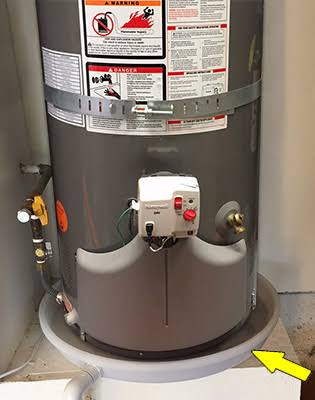
A couple in HB had their house remodeled. When their contractor was setting the finish, they realized nobody had put in a water heater — no unit, no space left for one, no water lines run to where one should be. The old water heater closet on the back of the house had been demolished during the tear-out and forgotten. The couple, understandably, was not laughing.
We put a Noritz up in the attic directly above the master bathroom, tied it into the main hot line right there, and gave them near-instant hot water at the fixtures below. Because it was a condensing unit, the venting was easy — standard PVC. We set the unit in a drain pan with a moisture sensor and alarm, so any leak would be caught before it made it through the ceiling. Years later, no issues.
Case #3 — Garden Grove, near the high school: peaceful mornings
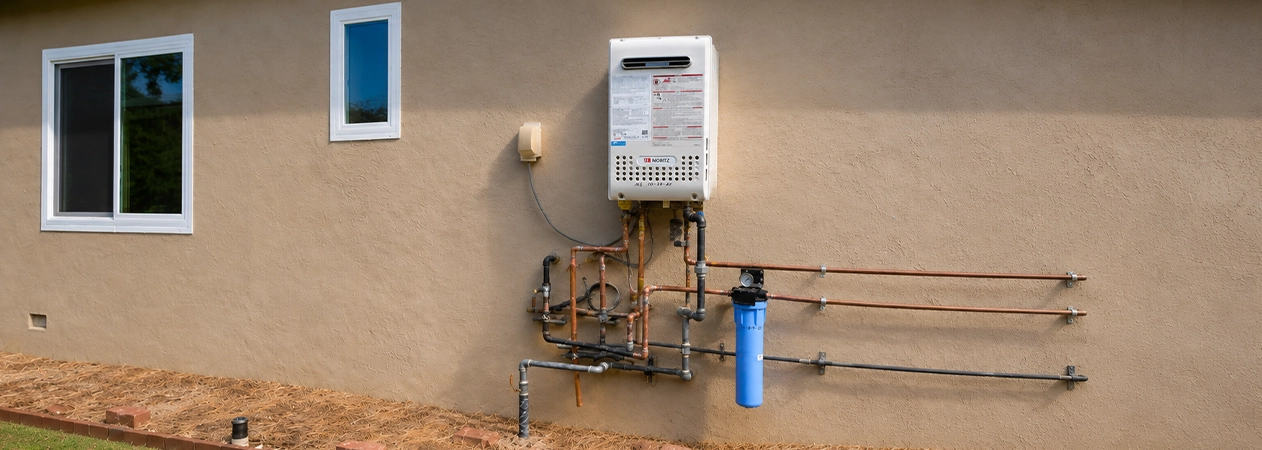
A family in a modest Garden Grove home called because their mornings had become impossible. Two teenage daughters, plus the wife, all trying to get ready between six and seven — and one 40-gallon tank feeding it all. Fights over hot water were breaking out daily. We came in and instead of recommending a bigger tank, suggested a tankless. We put in a Noritz NRC 98, knowing they’d routinely run two showers at once.
We didn’t hear from them for years. When we got called back out for an unrelated leaky bathroom valve, the father — not the mother — spent half the visit talking about how peaceful the mornings had become. Said the extra money over a tank was the best money he’d spent on the house because it made his life so much calmer.
Why does a tankless need annual maintenance in Orange County?
Orange County water runs 8 to 19 grains per gallon — hard by any measure. A tankless heat exchanger is a bundle of narrow tubes, and hard-water scale builds up inside those tubes until flow drops, temperature can’t hold, and the unit throws a fault code. An annual flush prevents it. Skip the flush and you can lose 5 to 10 years off the unit’s lifespan.
The flush itself takes about 45 minutes to an hour. We circulate a food-grade descaling solution through the heat exchanger to dissolve scale, then flush it clean. Vinegar technically works, but the food-grade descaler works significantly better. While the solution is running through, we’re not standing around — we check the gas manifold, the air intake, the venting, and the general condition of the unit. The flush is the reason for the visit; the once-over is because we’re already there.
The exception on frequency: if your home has a whole-house water softener or filtration system, and the year-one flush shows very little sediment coming out, we can extend to a two-year flush cadence. Filtration reduces the need for descaling — it doesn’t eliminate it. General maintenance (gas manifold, intake, burn check) still matters in between.
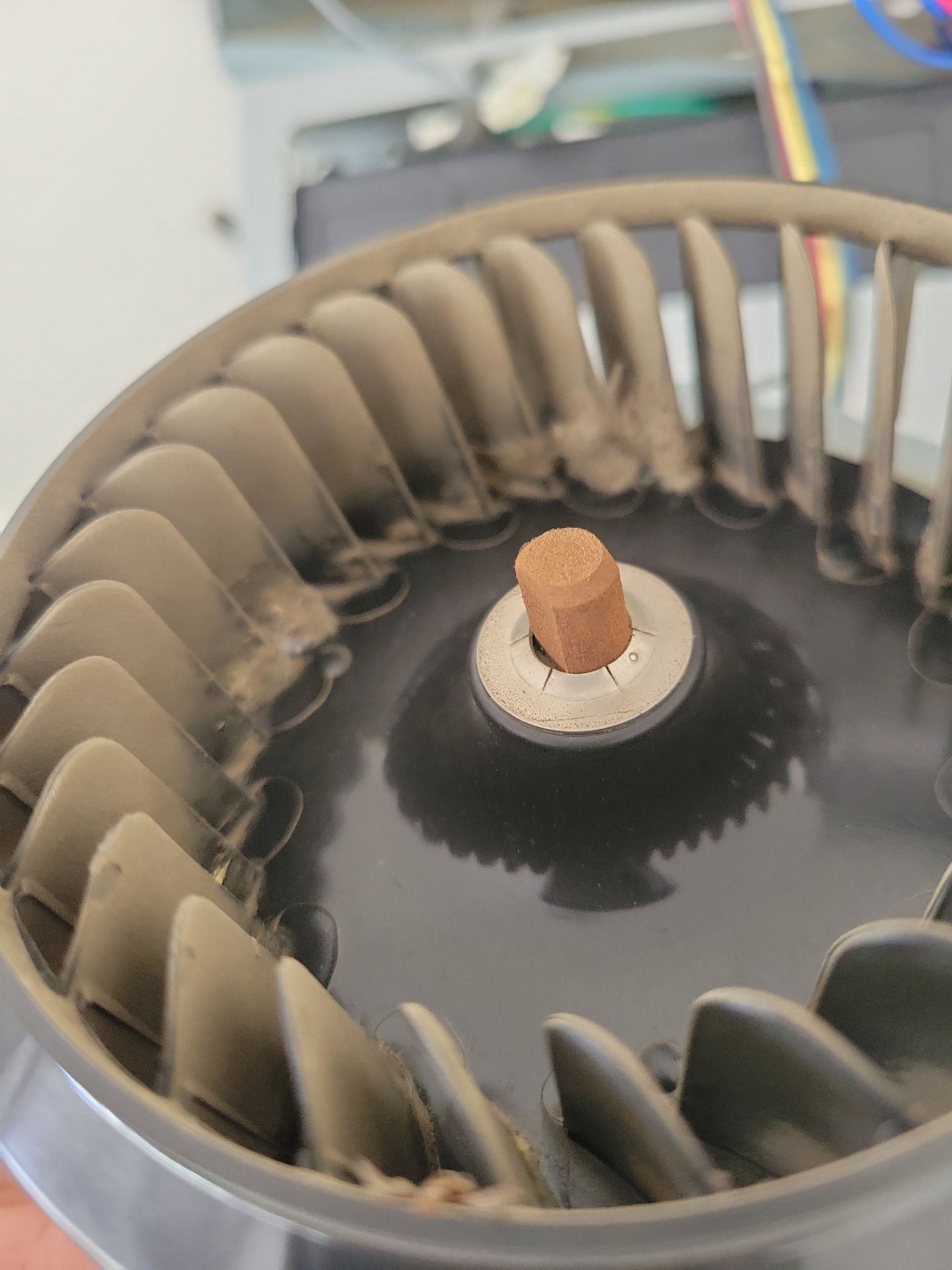
The other quiet killer we see in the field: tankless units installed in laundry rooms. The lint from the dryer gets pulled into the tankless’s combustion air intake, blocks it, and the unit throws combustion-air fault codes and won’t fire. Fix is straightforward — clean everything out, remove the lint — but if your tankless lives in the laundry room, that’s a call we’ll be making more than once.
What happens when maintenance gets skipped: homeowner doesn’t change the pre-filter, doesn’t schedule a flush, pre-filter fills up, the unit starts throwing overtemperature codes, and eventually the thermal fuse blows. The thermal fuse itself is a cheap part. The labor is not — you have to tear the unit down to reach it. A preventive flush costs a fraction of a thermal fuse replacement.
Can I replace my 40- or 50-gallon tank with a tankless?
Yes, absolutely — but you’re not replacing gallons, you’re replacing flow rate. A 40- or 50-gallon tank’s rating tells you how much hot water it holds; a tankless’s rating tells you how much it can deliver per minute. Those aren’t the same thing, and the tank rating tells you nothing about the tankless you’d need.
Here’s the practical version: if you run two showers, a bathroom sink, and a laundry all at the same time in your current 40- or 50-gallon setup, you’re going to run out in about five minutes. Size a tankless for that same demand and you’ll never run out. You may see a slight dip in water pressure at the tap, depending on the unit — that’s the flow valve doing what we described in the downsides section — but you won’t run cold.
For the actual math — what GPM you need, what BTU that translates to, what gas line size the run requires — use our tankless selector tool. It walks through the numbers with your inputs and narrows all 67 models we install down to the ones that will actually fit your home. Don’t try to convert gallons to BTUs; use the selector.
What NOT to do when choosing a tankless water heater
Five things we warn homeowners about — because we see the aftermath. The first three are the specific traps we see other installers set for competing bids.
- Don’t accept a bid that reuses your old gas line without recalculating. The biggest and fastest way to kill a tankless is undersizing the gas line. A tankless fires at up to six times the peak of a tank, and your existing line was sized for the tank. Our selector tells you exactly what size line you need based on distance from the meter. If a competing bid says “we’ll use your existing line” without showing you the developed-length calculation, that’s a red flag.
- Don’t miss the electrical requirement buried in the fine print. A tankless needs a nearby electrical outlet. If your water heater closet doesn’t have one, someone has to run electrical to it. We’ve bid against installers who casually mentioned in the contract that the homeowner would need to provide their own electrical — but didn’t explain what that meant or what it would cost. The bid looked cheaper by exactly the amount of the hidden work.
- Don’t get sold a smaller unit “sized for summer.” Some installers pitch a smaller (cheaper) tankless based on OC’s summer water temperature, when the temperature rise is smaller and a smaller unit can keep up. Come winter, when incoming water drops and the rise nearly doubles, that unit runs out of capacity. In OC, size for winter. An NRC 71 that works in July won’t cover you in January.
- Don’t skip the annual flush. Every tankless warranty in the big three is conditional on annual maintenance. Skip a couple of years in OC water and you’ve voided the warranty AND cut years off the unit — and the failure mode isn’t a clean death, it’s a slow degradation you’ll blame on the unit when it was really the missed flushes.
- Don’t DIY the install to save money. The Home Depot Takagi that lands on our repair calendar is rare, but we repair those units a lot more often than we install them. The most common finding: gas line reused from the old tank without recalculating, extension cord running across the room to the outlet, and a unit that’s been running sooty and starved for years. Save a few hundred on install, spend a full replacement in five years.
Tankless water heater FAQ
What is the downside to a tankless water heater?
The three real downsides: the gas line often has to be upsized (the surprise cost), annual descaling is required in OC hard water or the warranty lapses, and there’s a brief cool-water pause when you cycle a tap off and back on quickly. None are dealbreakers, but they’re the honest ones.
Is it worth switching to a tankless water heater?
For most Orange County homes, yes — tankless lasts 20+ years vs 8-10 for a tank in our water, and the second install costs less than the first because the gas and vent work is already done. Where it’s not worth it: homes needing gas upsize, new electrical, AND a recirc add-on all at once.
How much does a tankless water heater cost in Orange County?
The install cost depends heavily on what’s behind the wall — existing gas line size, meter distance, venting path, whether the closet has electrical. That’s why we don’t publish flat prices. Every estimate lists the variables that apply to your specific home, with the price in writing before any work begins.
Can I replace my 40-gallon tank with a tankless?
Yes. Most 40-gallon tanks in Orange County can be replaced with a tankless — you size on flow rate, not gallons. Our tankless selector walks through the math for your specific home and shows you which models fit your gas line and household demand.
Can you run two showers at once on a tankless?
Yes, if the unit is sized for it. Most Orange County homes need a tankless delivering about 3.6 GPM to run two showers simultaneously at winter temperature. That lines up with a 150,000-199,000 BTU unit — the class our Noritz NRC 98 default sits in.
Which brand is best — Noritz, Rinnai, or Navien?
All three are strong. Noritz is our default because their warehouse is 15 minutes from our shop and their EZ Series has a 25-year warranty. Rinnai wins on install simplicity. Navien wins on tech and built-in recirc. Match the brand to your home; the “number one brand” question has no single answer.
Can I install a tankless water heater myself?
You shouldn’t. Gas line sizing, venting, condensate routing, permit filing, and warranty registration all matter. DIY installs are the reason customer-supplied units land on our repair calendar within a few years, usually from an undersized gas line that starves the unit and sooties the heat exchanger.
How does a tankless water heater work?
A tankless heat exchanger works like a car radiator in reverse. Instead of blowing cold air through the fins to cool the water inside, a tankless runs a gas flame through the heat exchanger to heat the water as it flows through. Cold in one end, hot out the other. No storage tank, no standby loss.
How long do tankless water heaters last?
The U.S. Department of Energy puts tankless lifespan at more than 20 years — double a tank’s 8-10 years. Actually reaching 20 depends on the annual flush; skip it in OC water and scale kills the heat exchanger early. Our oldest serviced unit is a 2007 install, still running fine.
Do tankless water heaters need special venting?
Yes. A tankless can’t reuse the old steel vent from a tank. A condensing unit vents in inexpensive plastic (PVC or CPVC). A non-condensing unit needs Category III stainless venting, which is significantly more expensive. Outdoor-mounted units don’t need any venting at all.
Ready to install?
If you’ve decided a tankless is right for your home, the install is where it’s won or lost — the gas line, the venting, the sizing, the location. Our tankless installation page covers exactly what the job involves, and every estimate is free and on-site with the price in writing before any work begins.
About the author
William J. Horsky Jr. is the owner of Professional Plumbing, Inc. He founded the company in Orange County in 1985 and has served the area continuously since then. Professional Plumbing has been licensed by the California Contractors State License Board since 1987 (CSLB license #517514, C-36, current and active) and was incorporated in 2001. The company operates from offices in Fountain Valley, Garden Grove, Huntington Beach, Costa Mesa, and Newport Beach, and serves homeowners and businesses across Orange County. Every one of our techs is factory-trained — much of that training happens in Fountain Valley, the same city as our shop.
Have a question?
If you’re weighing a tankless water heater, comparing quotes, or working through a project on your own, you’re welcome to call. The number is (714) 964-3519.
During business hours you’ll reach me or one of my guys. After hours, our AI assistant can answer common questions or take down your information, and I’ll follow up the next business day. In an emergency, the AI assistant can connect you directly to a plumber on request.
No obligation to schedule service. Sometimes a phone call answers what a page can’t.
William J. Horsky Jr.
Owner, Professional Plumbing, Inc.
Serving Orange County since 1985.